

- Date of Incident
- 24 Feb 2022 – 16 Mar 2022
- Location
- Donetsk Academic Regional Drama Theatre, Mariupol, Ukraine
- Publication Date
- 16 Mar 2023
- An FA-supported project by
- The Center for Spatial Technologies (CST), Forensis
- Collaborators
- None
- Methodologies
- 3D Modelling, Fieldwork, Geolocation, OSI, Photogrammetry, Situated Testimony
- Forums
- Media
- Exhibitions
- —

This video is the first in a two-part collaboration between Forensis and the Center for Spatial Technologies, supported by Forensic Architecture.
The airstrike which destroyed most of the Mariupol Drama Theatre on 16 March 2022 was a dark milestone in the early weeks of the Russian invasion of Ukraine.
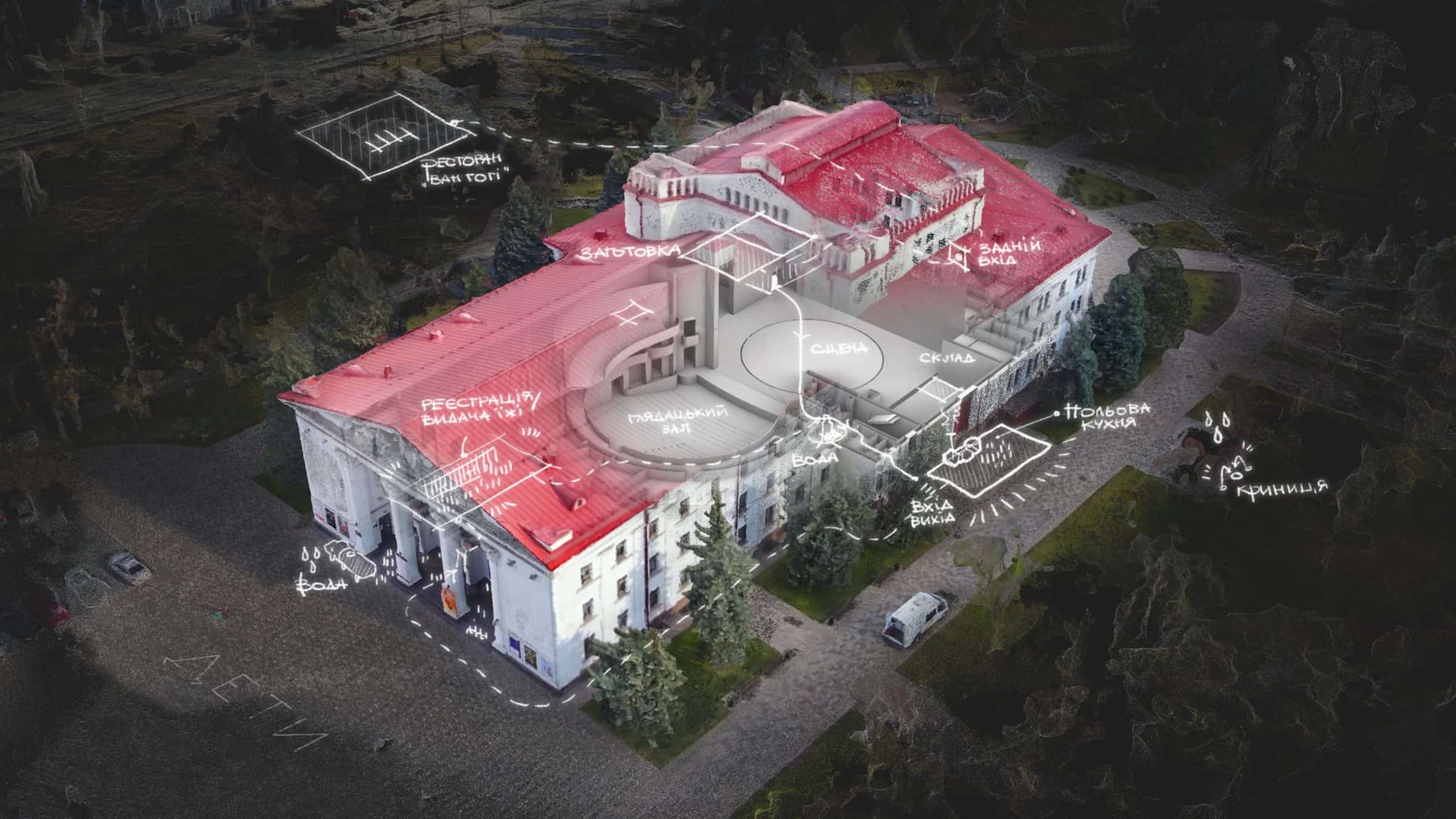
The theatre had sheltered thousands of civilians during the siege of Mariupol, its population rising as Russian bombardments grew ever closer to the heart of the city, and the civilian population fled or sheltered.
Outside the theatre, the word “CHILDREN” (“ДІТИ”) was written on the ground, large enough to tell aircraft overhead that the building was a shelter, not a military target. Nevertheless, a Russian missile struck the building, in what was among the war’s one of the deadliest airstrikes against civilians.
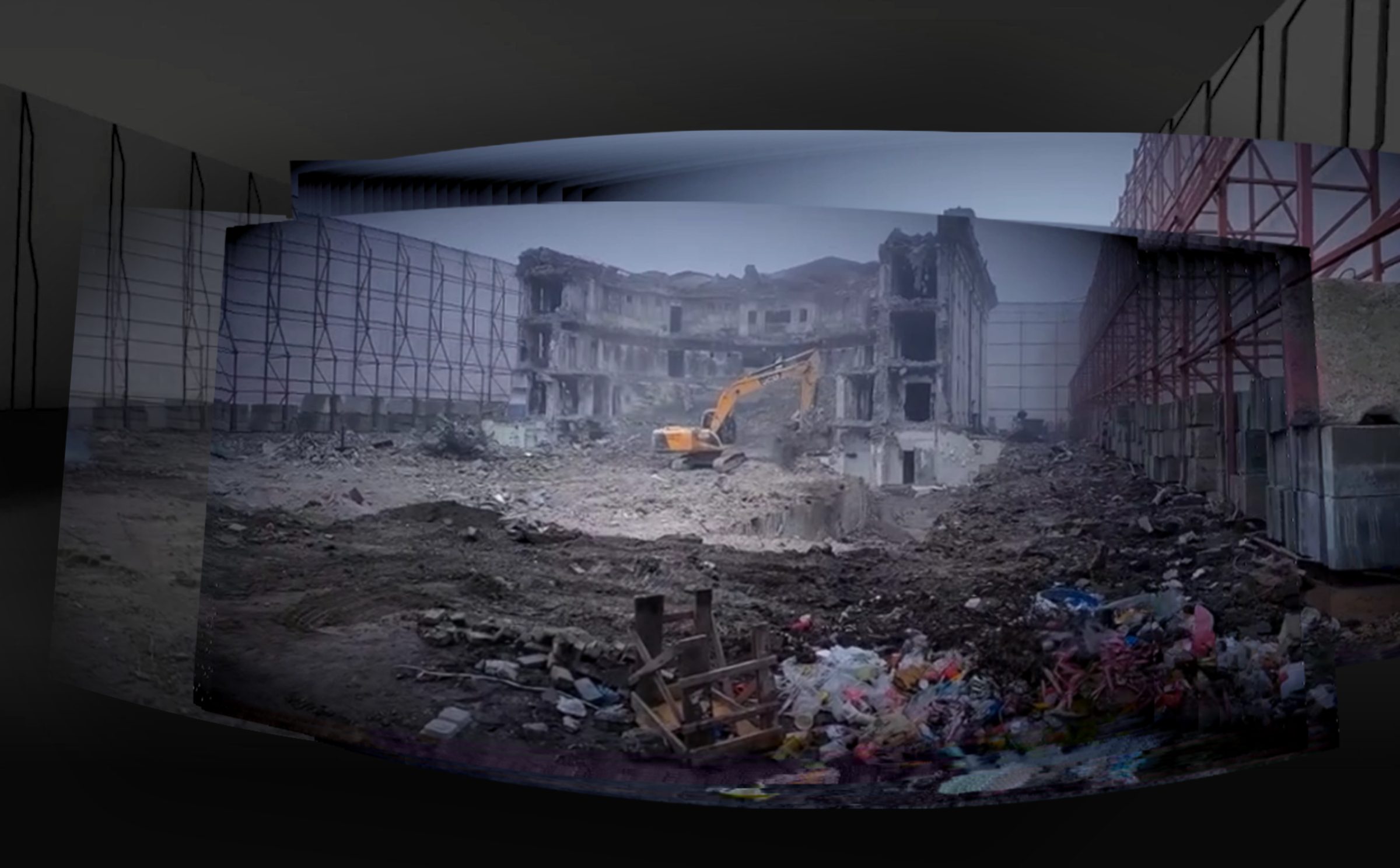
After the attack on civilians came the attack on evidence. After Russian forces took control of Mariupol, the occupying authorities actively sought to erase evidence related to the strike on the theatre. Pro-war bloggers were invited from Russia to record videos which argued that Ukraine had destroyed the building in a ‘false flag’ attack. Concerts celebrating Russian nationalism were held in front of the ruins of the theatre. And in late 2022, the theatre was boxed in by scaffolding and sight-screens, and bulldozed to the ground.
The theatre’s final destruction was an erasure not only of Ukrainian cultural heritage, but also of potential evidence of a grave war crime. The airstrike occurred when there was no mobile signal in Mariupol, and all phones were checked by the Russian occupiers’ ‘filtering’ stations on the way out of the city. The occupation authorities also took care to carefully conceal the facts of the war crime with the help of excavators and propaganda. In erasing the physical evidence of the airstrike, Russia also removed the last traces of a cultural landmark that was central to Mariupol’s historical identity.
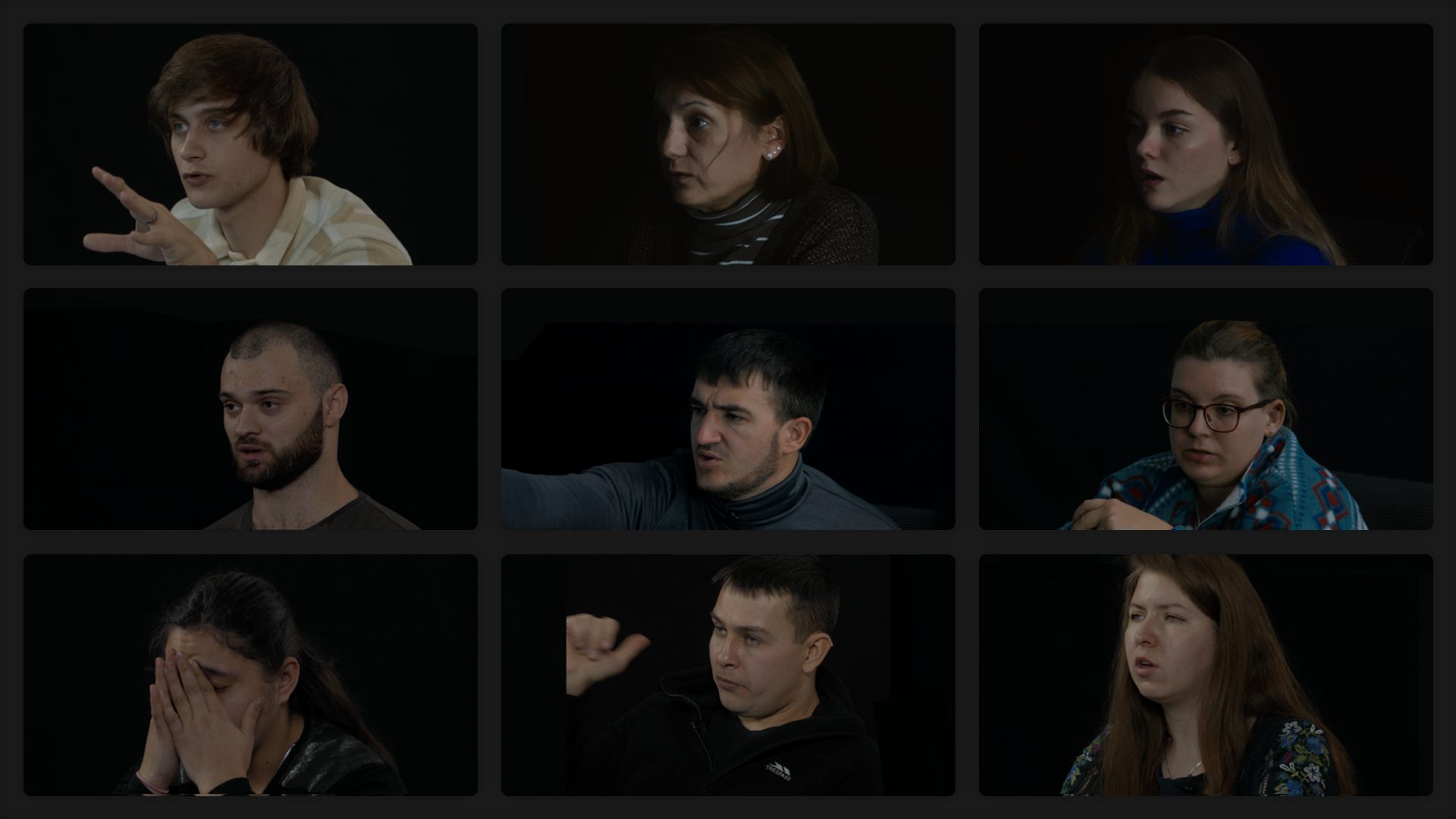
In defiance of that erasure, the Center for Spatial Technologies (CST), an architectural research collective based between Kyiv and Berlin, set out to explore the theatre’s history, its transformation into a shelter during the Russian invasion, and the destruction of its memory.
The team collected and analysed thousands of photos, videos, and social media posts, and recorded more than 100 hours of interviews with witnesses. In the absence of physical evidence, and with much digital evidence also destroyed, the recollections of those witnesses are an essential historical document. Combined with open source data and the tools of spatial research, including digital models and photogrammetry, these recollections constitute a living archive, a memory of the event of the theatre’s destruction, and a commemoration of what was destroyed—an act of resistance, a self-organised commune, and an entire city within a single building.
Updates
Update — 19 March 2024
For the two year anniversary of the bombing of the Marioupol drama theatre by the Russian military, CST with the support of Forensis has released in-depth witness testimonies, a legal assessment by ECCHR as well as an explosion analysis and a fully navigable 3D digital reconstruction of the now destroyed theatre on the Spatial Archive (view here).
Widening the scope and depth of analysis, this multi-directional investigative research combines both on-the-ground experiences with legal assessments and digital reconstruction to further consolidate the efforts to preserve critical evidence and the memory of the theatre once a centrepiece of a Ukrainian Mariupol free from Russian occupation.