The Bombing of Rafah
Forensic Architecture

The kidnapping of an Israeli soldier by Hamas during the 2014 Gaza conflict resulted in four days of bombardment, in which over two thousand homes were destroyed.

Lt. Hadar Goldin’s abduction led Israeli military leadership to implement what was known as the Hannibal Directive, a classified military order that is understood to permit Israeli soldiers, in the event of a fellow soldier’s capture by enemy forces, to target the captive and his captors with maximum available firepower, regardless of the risk to the captive soldier’s life. The bombardment of Rafah on 1 August was intended to destroy the tunnels under the city into which the soldier had been taken.

Amnesty International and Forensic Architecture (FA) were denied entry into the Gaza strip, and as such our investigation into the bombardment of Rafah relied on thousands of images and videos shared online, or sent directly to FA, by citizens and journalists.

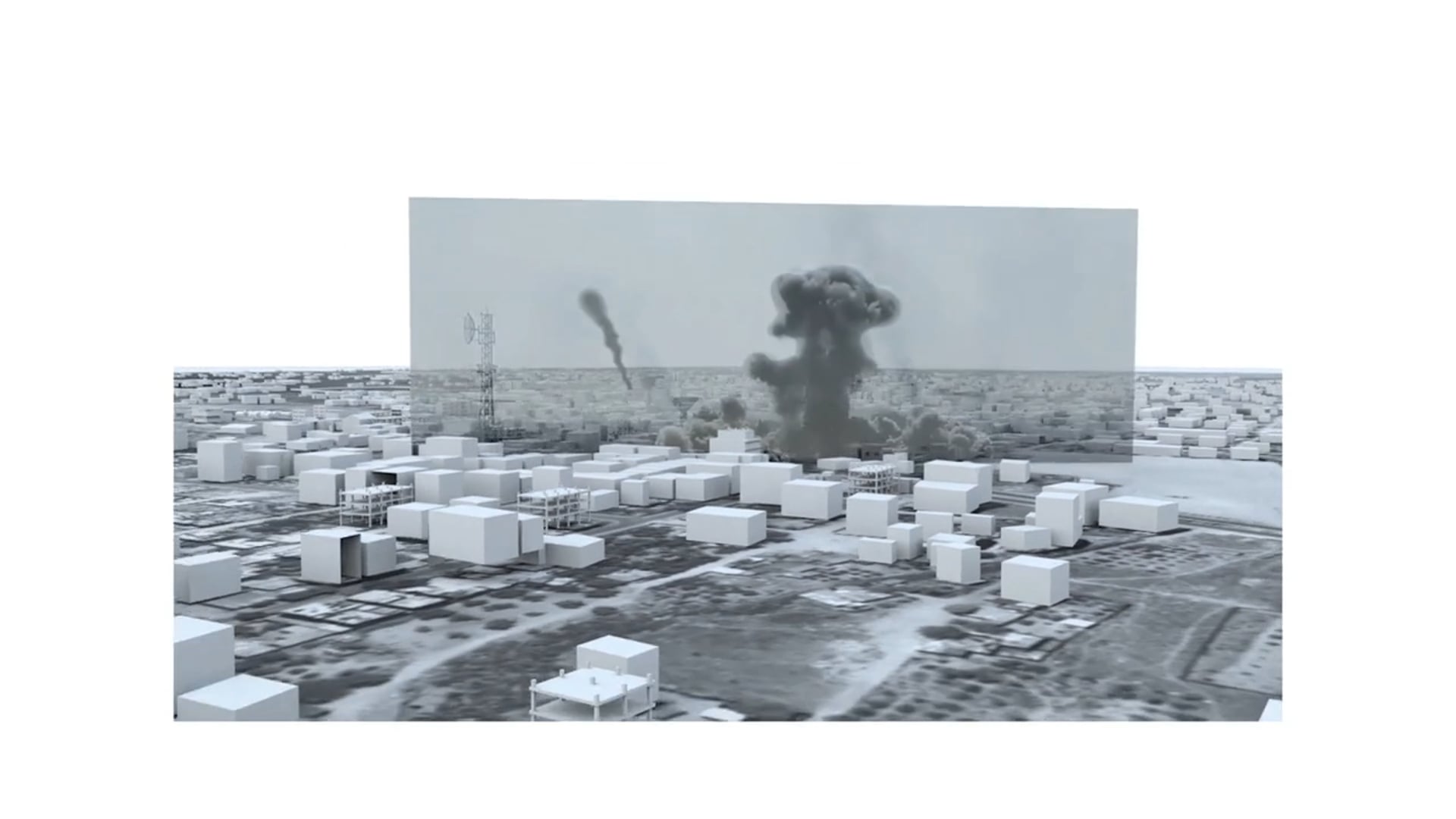
Through a process of locating cameras and incidents within a digital model, and subsequent analysis of satellite and ground-level images, smoke clouds, shadows and impact craters, we mapped hundreds of air-to-surface and artillery strikes that hit the city of Rafah on 1 August.
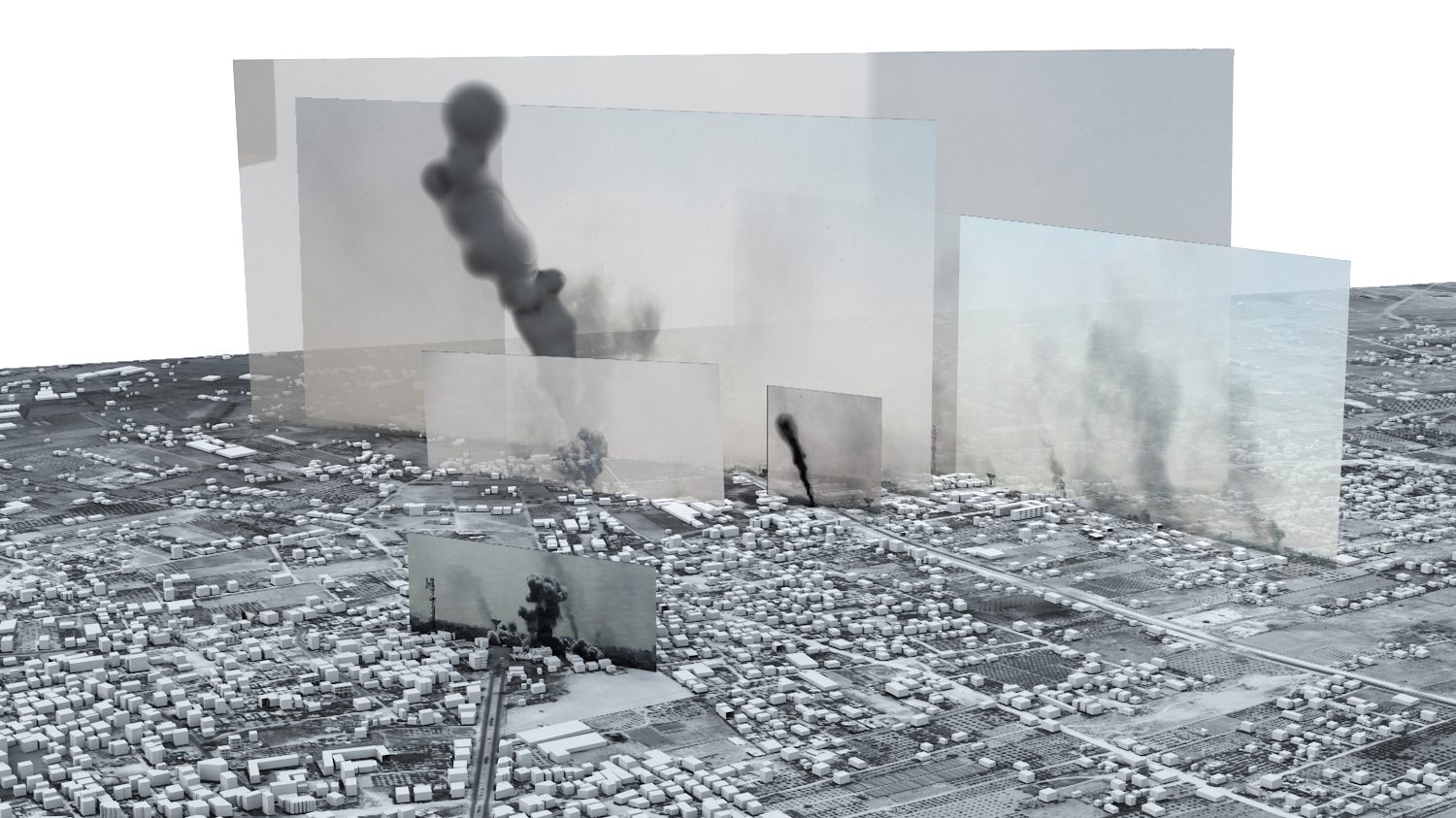
Image Complex – 1 - Multiple images and reconstructed bomb clouds are arranged within a 3D model of Rafah, Gaza. (Forensic Architecture)
Multiple images and reconstructed bomb clouds are arranged within a 3D model of Rafah, Gaza. (Forensic Architecture)

Our research supported the following conclusions by Amnesty International in their report ‘Black Friday: Carnage in Rafah’:

There is overwhelming evidence that Israeli forces committed disproportionate, or otherwise indiscriminate, attacks which killed scores of civilians in their homes, on the streets and in vehicles and injured many more. This includes repeatedly firing artillery and other imprecise explosive weapons in densely populated civilian areas during the attacks on Rafah between 1 and 4 August. In some cases, there are indications that they directly fired at and killed civilians, including people fleeing.
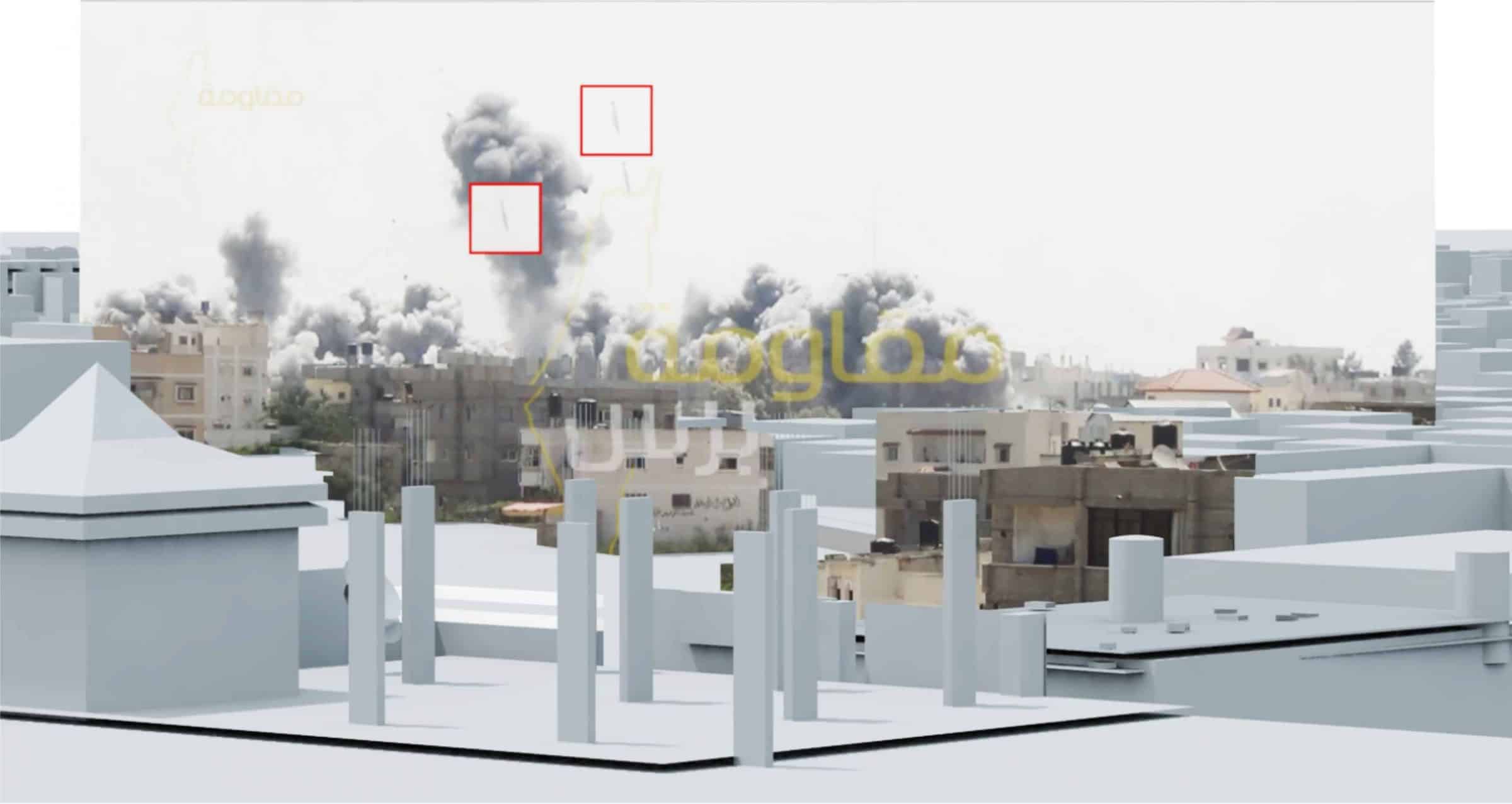
Al Tannur – Missile stills - Video still showing two bombs in mid­air fractions of a second before impact in the Al Tannur neighbourhood in Rafah, Gaza. (Forensic Architecture)
Video still showing two bombs in mid­air fractions of a second before impact in the Al Tannur neighbourhood in Rafah, Gaza. (Forensic Architecture)

One of the videos we examined included two still frames that captured bombs mid-fall, fractions of a second before impact.

By locating the images within the 3D model, we were able to identify the bombs as one ton bombs. Amnesty International’s subsequent report identified the use of this munition as a war crime.
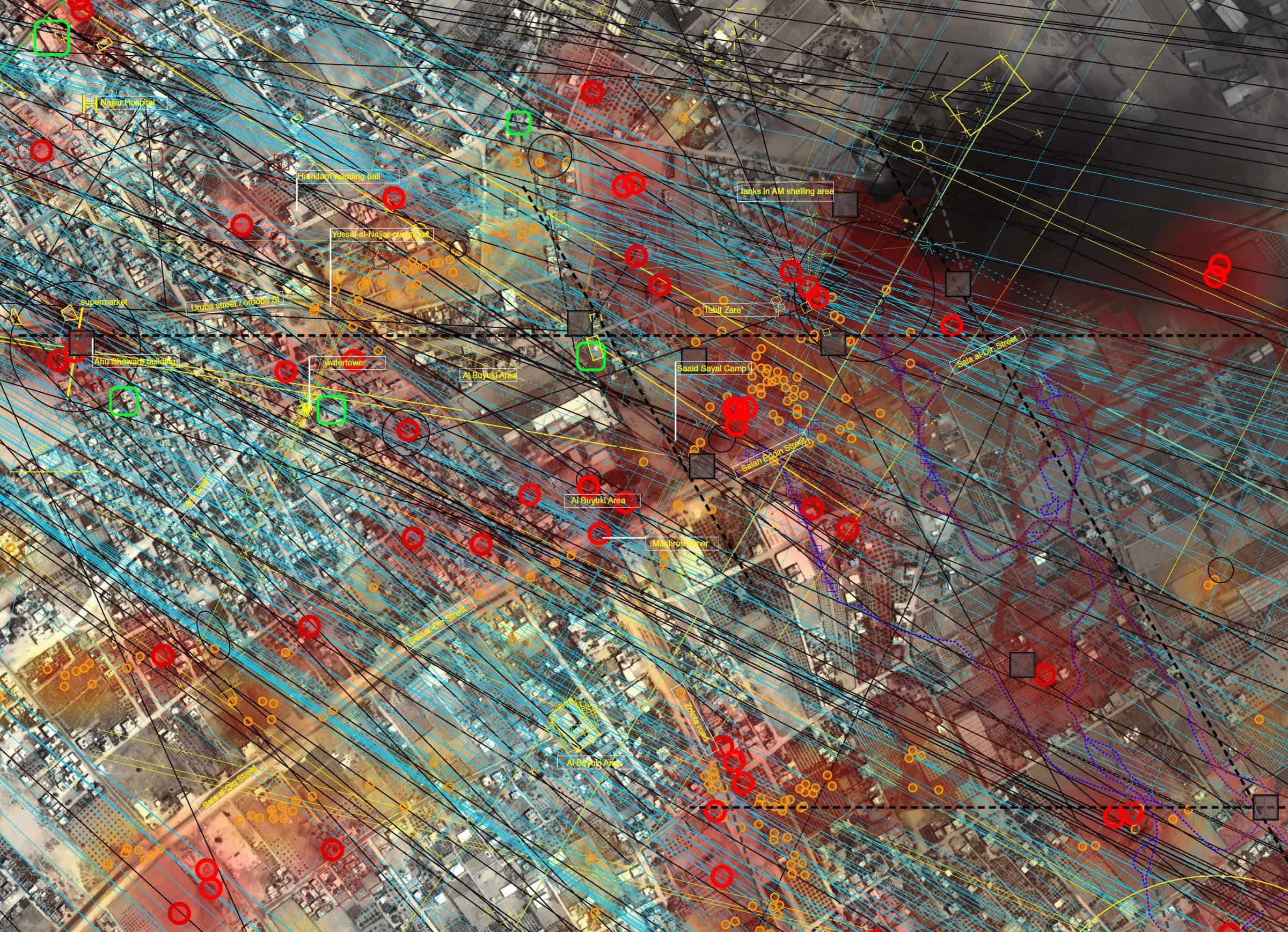
Collected Analysis - The master drawing of the Rafah investigation includes: viewpoints and plume measurements from every photograph and video sourced; craters from airdropped bombs and artillery as observed on the satellite images; tank paths and armoured vehicles on the move; reference points; location of possible tunnels; as well as testimony mappings. The base image is a Pléiades satellite photograph of eastern Rafah, taken on 1 August, 2014, 11:39am. (Forensic Architecture, 2015)
The master drawing of the Rafah investigation includes: viewpoints and plume measurements from every photograph and video sourced; craters from airdropped bombs and artillery as observed on the satellite images; tank paths and armoured vehicles on the move; reference points; location of possible tunnels; as well as testimony mappings. The base image is a Pléiades satellite photograph of eastern Rafah, taken on 1 August, 2014, 11:39am. (Forensic Architecture, 2015)

Play Video
Using a Normalised Difference Vegetation Index analysis of satellite imagery, Forensic Architecture detected the craters left by Israeli bombardment.

Play Video
Reconstruction of the paths of Israeli tanks during their incursions into the Gaza Strip during the 2014 conflict.

Methodology

Because social media tends to strip images of their original metadata, including time and location, FA had to piece together this information by studying elements within the image, such as shadows and the shape of bomb clouds, to locate each image in time and space and compose a narrative of the day.

‘Before’ and ‘after’ images were used to assess changes in site condition at attack sites under analysis. The ‘before’ satellite image served as a baseline from which any disturbance to the natural or built-up environment may be identified in the ‘after’ image.

Three satellite images were used in this project, dated 30 July, 1 August and 14 August. Each image extends westward from the Gaza-Egypt border to encompass central Rafah and was captured around 11.39am. The 1 August image, in particular, captures a moment only two and a half hours after the ceasefire collapsed, during the peak of the Israeli bombardment.

Forensic Architecture Team
Principal Investigator
Project Coordination
Research
Video Production
Website Design
Research Assistance
Project Support
Advisor
Extended Team
Legal Advisor
Remote Sensing
Video Production (Amnesty)
Fieldwork
Research Advisors
Advisors (Ballistics Analysis)
3D Modeling Assistance
UCL Bartlett MA Urban Design - Tutors
UCL Bartlett MA Urban Design
UCL Bartlett MA Urban Design - Students
UCL Bartlett MA Urban Design
Collaborators
UCL Bartlett MA Urban Design
Exhibitions
07 Oct 2022 – 08 Jan 2023
Cloud Studies at Tensta Konsthall
Stiftelsen Tensta Konsthall, Stockholm, Sweden
19 May – 22 Oct 2022
Forensic Architecture: Witnesses
Louisiana Museum of Modern Art, Humlebaek, Denmark
10 Oct 2021 – 02 Jan 2022
Biennale Nemo
Biennale Nemo, CENTQUATRE, Paris
02 Jul – 17 Oct 2021
Cloud Studies at the Whitworth
The Whitworth, Manchester, United Kingdom
23 Oct 2020 – 03 Jan 2021
Antibodies
Palais de Tokyo, Paris
22 Sep – 13 Nov 2020
Cloud Studies at UTS Gallery
UTS Gallery, Sydney
10 Jul – 01 Nov 2020
Enter the Void
Kunsthalle Mainz, Mainz, Germany
27 Mar – 16 May 2020
The Image Looks Back at PHOTO 2020
RMIT Gallery, Melbourne
19 Feb – 27 Sep 2020
Forensic Architecture: True to Scale
Freedom Tower, Museum of Art and Design at Miami Dade College
28 Sep – 23 Nov 2019
Violence, Fast and Slow
State of Concept, Athens
18 Oct 2018 – 27 Jan 2019
Forensic Justice
BAK, Basis Voor Actuele Kunst, Utrecht, Netherlands
03 Sep – 03 Nov 2018
Change the System (Extension)
Dutch Police Academy, Apeldoorn, The Netherlands
07 Mar – 13 May 2018
Counter Investigations
The Institute of Contemporary Arts (ICA), London
14 Oct 2017 – 14 Jan 2018
Change the System
Museum Boijmans van Beuningen, Rotterdam
09 Sep – 30 Dec 2017
Forensic Architecture: Hacia una Estética Investigativa
Museo Universitario Arte Contemporáneo (MUAC), Mexico City, Mexico
08 Sep 2017 – 07 Jan 2018
The Other Architect
Het Nieuwe Instituut, Rotterdam, The Netherlands
20 May – 17 Sep 2017
Situation #82: Bomb Cloud Atlas
Fotomuseum Winterthur, Switzerland
28 Apr – 15 Oct 2017
Forensic Architecture: Towards an Investigative Aesthetics
Museu d’Art Contemporani de Barcelona (MACBA), Barcelona, Spain
10 – 26 Feb 2017
The Urban-Data Complex
Tokyo Photographic Art Museum, Tokyo, Japan
02 Oct – 10 Jan 2016
Burden of Proof
The Photographers' Gallery, London, UK
01 Aug 2016
Obliterated Families Project
Online exhibition
02 Jun – 25 Sep 2016
Constellation.s
Arc en Rêve Centre d’Architecture, Bordeaux, France
28 May – 27 Nov 2016
Forensic Architecture at Venice Architecture Biennale 2016
Giardini della Biennale, La Biennale di Venezia, Venice, Italy
05 Mar – 10 Jul 2016
The Next Big Thing Is Not A Thing
Bureau Europa, Maastricht, Netherlands
09 – 21 Feb 2016
Artefact 2016 | Up in the Air
STUK Kunstencentrum, Leuven, Belgium
04 Dec 2015 – 04 Mar 2016
The Urban-Data Complex at Bi-City Biennale of Urbanism/Architecture 2015
Shenzhen Public Art Center, Bi-City Biennale of Urbanism/Architecture, Shenzhen, China
28 Oct 2015 – 10 Apr 2016
The Other Architect
The Canadian Centre for Architecture (CCA), Montreal, Canada
11 – 17 Sep 2015
Kent Klich: Black Friday
Malmö Konsthall, Malmö, Sweden
Events
23 Oct 2020 – 03 Jan 2021
Antibodies
Palais de Tokyo, Paris
22 Sep – 13 Nov 2020
Cloud Studies at UTS Gallery
UTS Gallery, Sydney
10 Jul – 01 Nov 2020
Enter the Void
Kunsthalle Mainz, Mainz, Germany
27 Mar – 16 May 2020
The Image Looks Back at PHOTO 2020
RMIT Gallery, Melbourne
28 Sep – 23 Nov 2019
Violence, Fast and Slow at State of Concept Athens
State of Concept, Athens
18 Oct 2018 – 27 Jan 2019
Forensic Justice
BAK, basis voor actuele kunst
07 Mar – 13 May 2018
Counter Investigations: Forensic Architecture
Institute for Contemporary Art, London, UK
14 Jun 2017
Research Aesthetics: Event and Footprint
Barcelona Museum of Contemporary Art, Barcelona, Spain
20 May – 17 Sep 2017
Situation #82: Bomb Cloud Atlas
Fotomuseum Winterthur, Winterthur, Switzerland
10 – 26 Feb 2017
Urban-Data Complex
Tokyo Photographic Art Museum, Tokyo, Japan
14 Oct 2016 – 22 Jan 2017
Design & Violence
Dublin Science Gallery, Dublin, Ireland
01 Aug 2016
Obliterated Families Project
Online exhibition, here: https://obliteratedfamilies.com/en/intro/
05 Mar – 10 Jul 2016
The Next Big Thing is Not a Thing
Bureau Europa, Maastricht, Netherlands
09 – 21 Feb 2016
Artefact 2016 - STUK - Up in the Air
STUK Kunstencentrum, Leuven, Belgium
28 Oct 2015 – 10 Apr 2016
The Other Architect - CCA
Canadian Centre for Architecture, Montreal, Canada
Press
24 May 2019
Information
Kan en Bygning Vidne om en Forbrydelse? Ja, mener disse arkitekter, der løser internationale kriminalgåder
25 Nov 2015
The Atlantic
An Architect's Investigation Into Urban Warfare
Publications
Forensic Architecture: Violence at the Threshold of Detectability
Related Investigations
The Killing of Rouzan al-Najjar
Khuzaa, Gaza · 01 Jun 2018
Cloud Studies
Worldwide · 2008 - Ongoing
The Beirut Port Explosion
Beirut, Lebanon · 04 Aug 2020
Russian Strike on the Kyiv TV Tower
Kyiv, Ukraine · 01 Mar 2022
Airstrikes on Minab Primary School
Shajareh Tayyebeh School, Minab, Iran · 28 Feb 2026