
- Date
- Now ⤻ 06 Jun 2026 – 30 Apr 2027
- Exhibition Type
- Solo
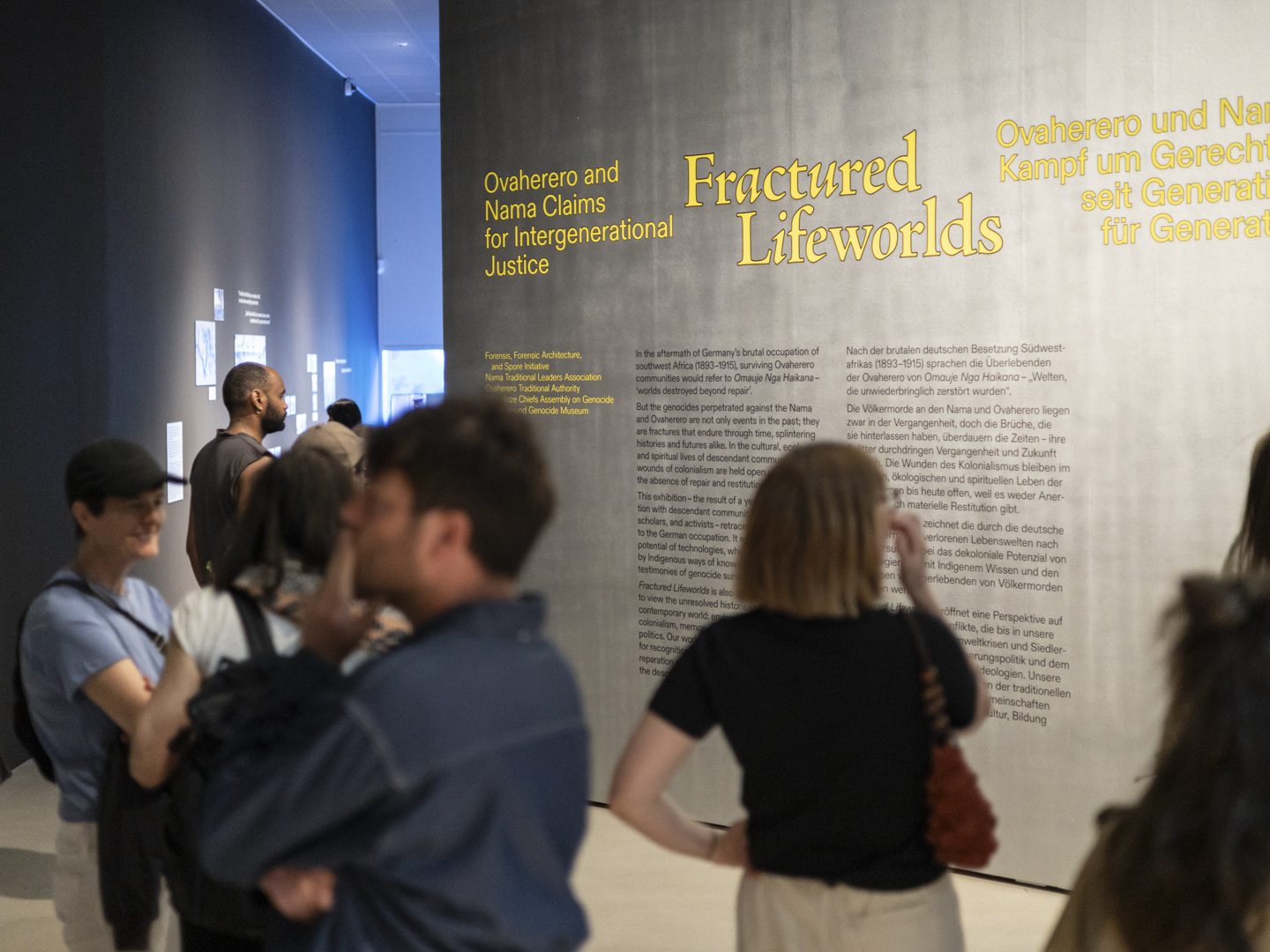
Installation views, ‘Fractured Lifeworlds’, Spore Initiative © Marvin Systermans & Esra Gültekin | Spore Initiative
Between 1884 and 1915, German colonial forces carried out genocides against the Ovaherero and Nama peoples in what is today Namibia. Ovaherero and Nama descendant communities, and the land their ancestors inhabited, are still living with that history, through altered environments, stolen territories, and inequalities that have outlasted the colonial period by more than a century.
Fractured Lifeworlds is an investigation into that inheritance.
The exhibition – developed over four years by Forensis and Forensic Architecture, in collaboration with researchers, descendant communities, oral historians, Indigenous scholars, and activists in Namibia and Germany – explores the legacy of Germany’s brutal colonization of southwest Africa (1884-1915), offering an account of ancestral lifeworlds lost to colonial violence.
Namibia’s colonial history is not remote. It is a lens through which to understand the unresolved histories which define the contemporary world – and Germany’s place within them. The continuities traced in this exhibition resonate with issues of environmental crisis, settler-colonialism, reparation, genocide, memory, and the resurgence of authoritarian and fascist politics.
Examining how colonial violence, dispossession, genocide, extractivism and environmental exploitation have been historically and contemporarily entangled, the exhibition seeks to show how both fractures remain open.
Through spatial analysis, satellite imagery, environmental modelling, archival research, and digital reconstruction, Fractured Lifeworlds explores how ‘green energy’ projects are reproducing colonial continuities, exposing the tensions between ‘green transition’ narratives and unresolved colonial injustices.
Seasons
Fractured Lifeworlds unfolds over three seasons – Bush, Wind and Sand – each reflecting an aspect of Namibia’s landscapes, and highlighting a different cluster of research within the collaborative project.
The first season opens among the bush landscapes of Namibia’s interior, where displacement and resistance shaped the early phases of the genocides. As the seasons progress, the exhibition’s focus transitions towards the coastal Namib Desert, where German colonial troops weaponised the region’s climate to pursue the extermination of its inhabitants.
Each season will feature contributions by Namibian artists, in a living dialogue between artistic practice and investigative research.
Bush: The Environmental Continuum of Genocide | June 6 – October 4, 2026
Wind: The Architecture of a Death Camp | October 10, 2026 – January 24, 2027
Sand: The Topography of Erasure | February 6, 2027 – April 30, 2027