
- Date
- 10 – 30 Jul 2026
- Exhibition Type
- Group
Twenty-five years after the Genoa G8, the central question is no longer only what happened in July 2001, but how events are reconstructed, evidence produced, and public accountability established in a society shaped by the continuous production of images, data, and AI systems.
From contemporary wars to human rights violations, from forms of institutional violence to environmental conflicts, the search for truth increasingly relies on the analysis of visual and digital traces. Photographs, videos, audio recordings, satellite imagery, and geospatial data have become essential tools for documenting events, verifying testimonies, and reconstructing what happened.
POINTS OF VIEW aims to transform the memory of the Genoa G8 into a lens through which to reflect on the present, placing at its centre the role of images in the construction of facts, judicial proceedings, and public debate.
Genoa 2001 represents a pivotal moment in this history. For the first time, photographs, amateur footage, journalistic videos, and audio recordings were systematically collected, synchronised, and analysed within complex judicial proceedings. From that experience emerged forms of visual counter-investigation that, although developed in an experimental context, anticipated some of the principles that today underpin image-based forensic investigations.
Through audiovisual installations and contemporary research materials, the exhibition connects the experience of the Genoa G8 with the most advanced investigative practices developed over the past twenty-five years. Its purpose is not simply to recount a historical event, but to explore how truth is constructed, verified, and contested in an age of continuous image and data production.
The exhibition is organised into two complementary sections.
G8 Frames – Four Points of View, One Event: The images of the Genoa G8 as the starting point for practices of visual counter-investigation.
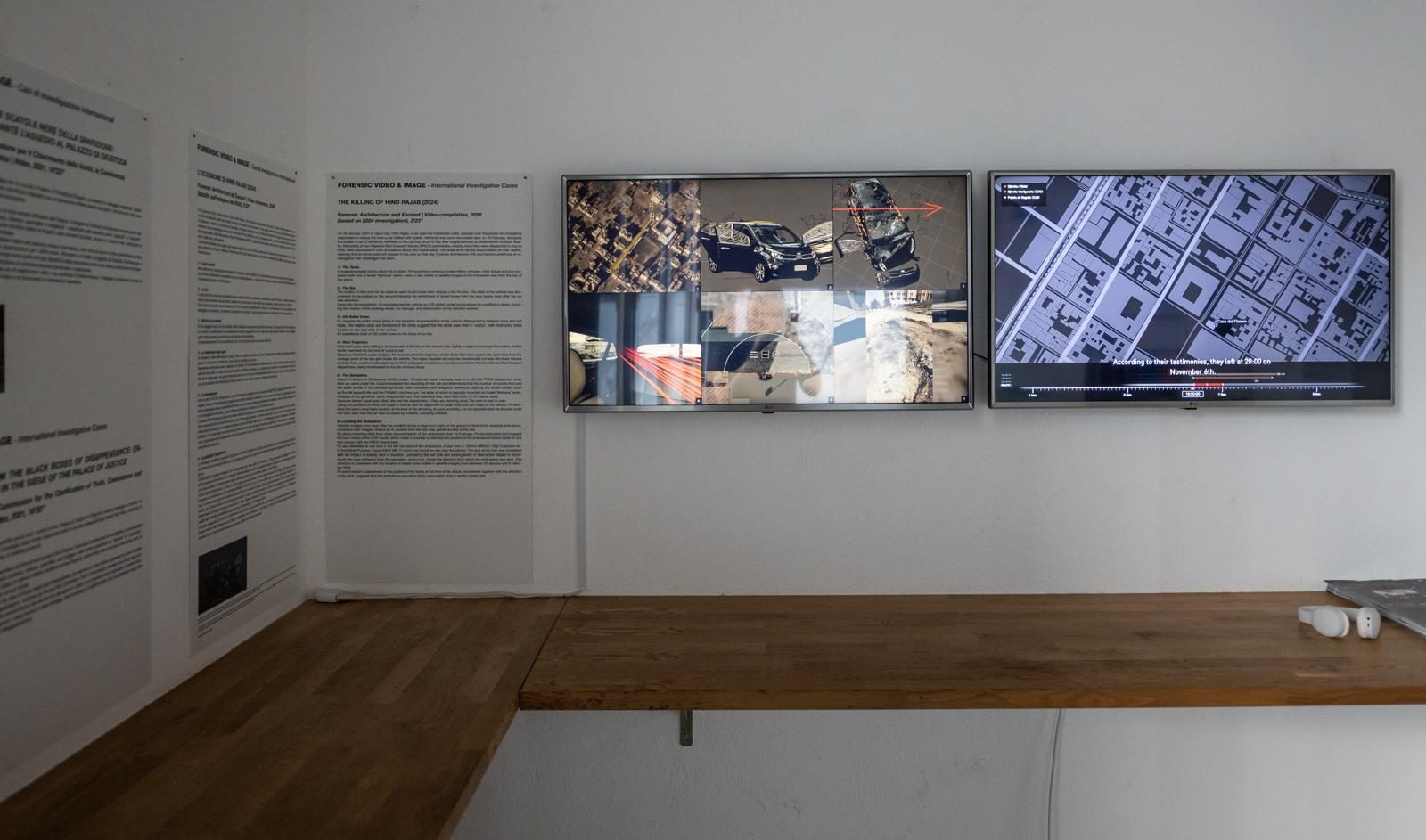
Video & Image Forensics – International Investigation Cases: Contemporary forensic investigation methodologies through the work of Forensic Architecture.
Although they emerged in different historical, technological, and institutional contexts, the practices developed by the Legal Secretariat of the Genoa Legal Forum after 2001 anticipated some of the principles that today characterize the most advanced forms of image-based forensic investigation. The project connects the Genoa experience with the work of Forensic Architecture through a number of shared elements: the use of images as sources of evidence, the temporal synchronisation of materials originating from different sources, the verification and contextualisation of digital evidence, the geolocation of events, and the construction of alternative reconstructions that challenge official narratives.