
- Date
- 16 Mar – 01 Sep 2024
- Exhibition Type
- Solo
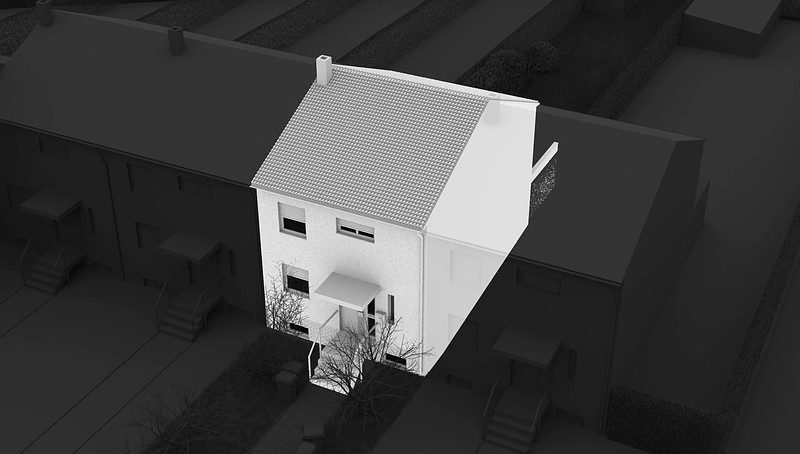
This exhibition has been organized around three investigations, each concerned with a door and an incident of racist violence in Germany.
Separating and connecting different domains—state, public, and private—doors are physical objects but also social contracts. Closed when they needed to be broken through, open when they needed to be shut, and locked when they needed to be unlocked, these doors embody a failure of the social order. To understand how, the investigations reconstruct the larger context around them, illuminating longstanding and troubling relationships between racist perpetrators and state agencies in Germany.
The first door is the emergency exit of the Arena Bar in Hanau-Kesselstadt, where six people were murdered on 19 February 2020. Survivors say they didn’t try to escape through the bar’s emergency exit because they knew it was locked; we showed that if it had been open, more people could have survived. Witnesses suggested that the police had previously pressured the bar owner to lock the emergency exit so that customers could not escape their frequent raids on the premises—exemplifying the systemic over-policing of racialized communities in Germany.
The second door is the front door of the perpetrator’s house, where he returned after the attack. Police failed to secure the house and did not break through the door for five hours after the attack; our investigation revealed damning new evidence about a string of police failures that speak to the German police’s well-documented complicity when pursuing perpetrators of racist violence.
The third door is that of the police custody cell in which Oury Jalloh, an asylum seeker from Sierra Leone, burnt to death in Dessau in 2005. Analysis of smoke traces left on the door of the cell prove that it was open for all or most of the fire’s duration. This suggests in turn that Oury was murdered by the very police officers that held him in custody.
Racist terror in Hanau, Dessau, and beyond, must be seen against the deep-rooted, structural racism latent in German state institutions and society. The pain and consequences of these murders will resonate over generations; the pursuit of accountability has already endured for many years.
Since its first presentation at the Frankfurter Kunstverein in 2022, subsequent exhibition at at Haus der Kulturen der Welt in Berlin (2022), and, in part, at the Neustädter Rathaus in Hanau (2023), Three Doors has influenced ongoing responses to the Hanau terror attack and Oury Jalloh’s murder in politics, society and the media, giving visibility to their continuing struggle, and shedding light on deeply entrenched racist structures within Germany.
In 2024, in addition to the Württembergischer Kunstverein Stuttgart, it will also be shown at the Museum im Kulturspeicher Würzburg.