
- Date
- 22 Feb 2020 – 26 Jun 2021
- Exhibition Type
- Group
In 1970 Japanese engineer Masahiro Mori introduced the concept of the “uncanny valley” as a terrain of existential uncertainty humans experience when confronted with autonomous machines that mimic their physical and mental properties. An enduring metaphor, the uncanny valley and its edges have captured the popular imagination ever since. In today’s AI-driven environment, where subjectivities and societies are increasingly organized and shaped by algorithms that track, collect, and evaluate our data, the question of what it means to be and remain human has shifted: no longer the sole purview of recognizable forms of corporeal or intellectual replication, it now must wrestle with the invisible mechanisms of behavioral engineering and automation. Uncanny Valley is the first major West Coast museum exhibition to unpack the tropes and modalities of AI through a lens of artistic practice.
Forensic Architecture’s contribution consists of three new pieces, as well as Triple Chaser (2019), a film made in collaboration with Praxis Films.
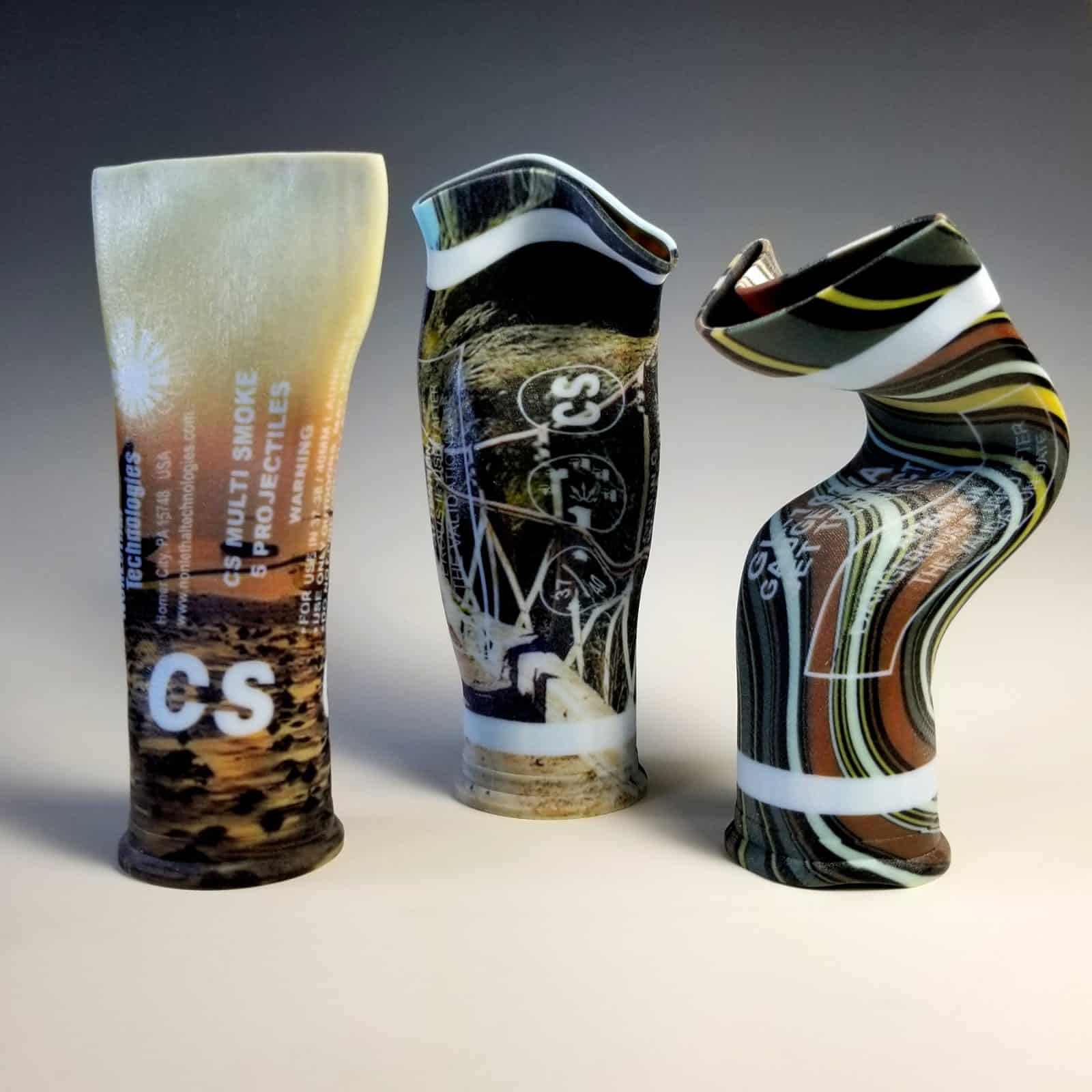
Premiering at the de Young Museum’s exhibition, Uncanny Valley, Forensic Architecture’s Model Zoo includes a growing collection of munitions and weapons as well as the different classifiers trained to identify them.
‘Computer vision’ relies increasingly on machine learning classifiers, algorithmic processes which can be trained to identify a particular type of an object. Training a classifier to recognise such objects usually requires thousands of images of that object in different conditions and contexts. For certain objects, however, there are too few images available. Since 2018, FA has been working with ‘synthetic images’—photorealistic digital renderings of 3D models—to train classifiers to identify such munitions.
Click here to see the associated machine learning studyCountering the abusive potential of machine learning, Forensic Architecture will pioneer their application to the pursuit of social justice. Their proposition of a Model Zoo marks the beginnings of a new research tool for civil society built of military vehicles, missile fragments, and bomb clouds—evidence of human-rights violations by states and militaries around the world.
Artfix Daily, 26 September 2019
Images: 3D printed by Moddler, LLC. 2020. A San Francisco, CA based 3D printing company.
Installation image by Randy Dodson. Image courtesy of the Fine Arts Museums of San Francisco