

- Date of Incident
- 12 Apr 2015 – 18 Apr 2015
- Location
- Mediterranean Sea
- Publication Date
- 18 Apr 2016
- Commissioned By
- Self-Initiated
- Additional Funding
- WatchTheMed Platform
- Collaborators
- None
- Methodologies
- Remote Sensing, Geolocation
- Forums
- Exhibition, Human Rights Report
- Exhibitions
- Counter Investigations, Forensic Architecture: Towards an Investigative Aesthetics, Forensic Architecture: Hacia una Estética Investigativa, Forensic Architecture at Venice Architecture Biennale 2016, République Géniale, Liquid Violence at Kunstenfestivaldesarts 2019, Liquid Violence at Manifesta 12, Liquid Violence at Short Festival
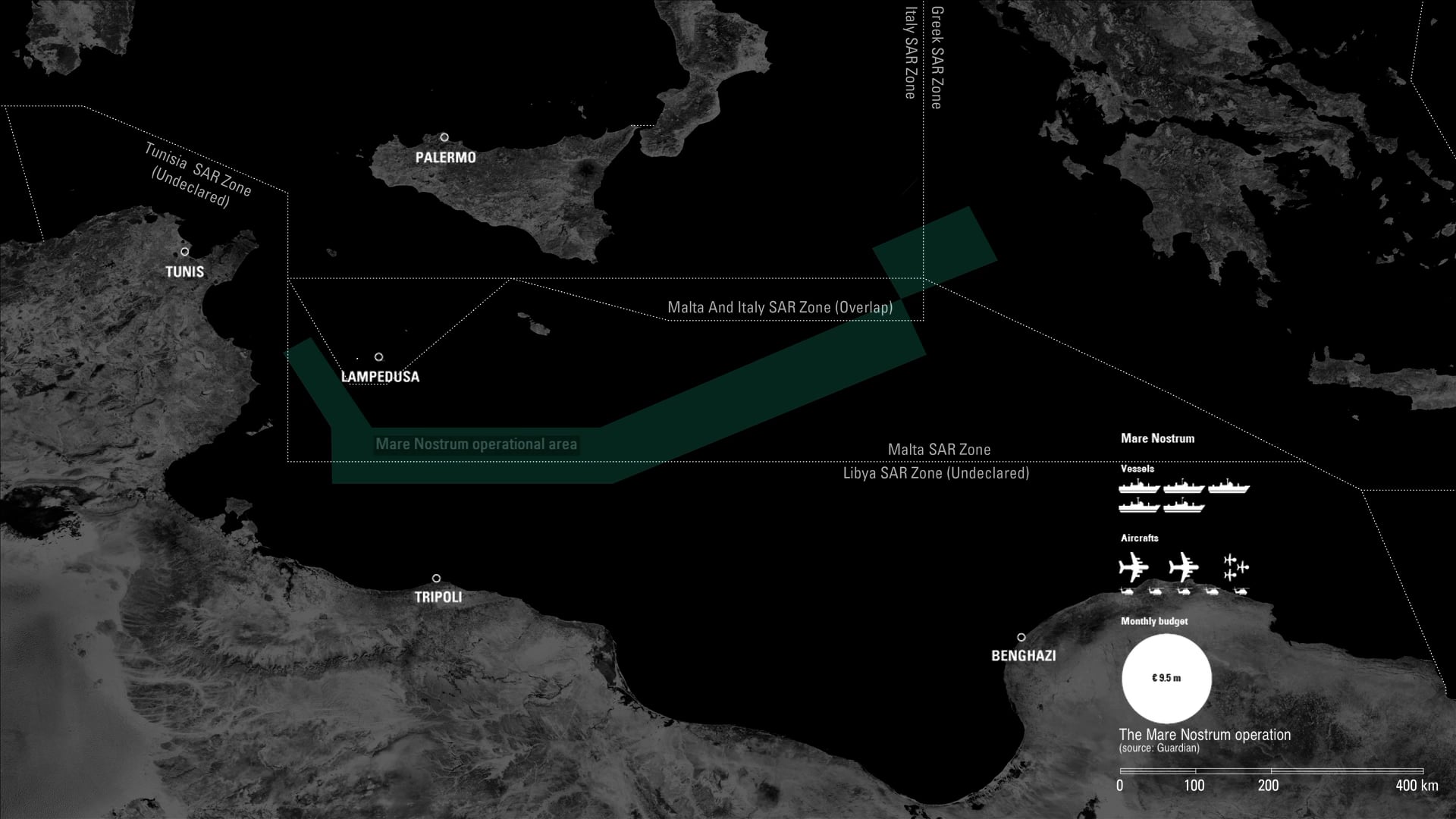
In April 2015, two shipwrecks in the central Mediterranean resulted in over a thousand deaths. The first, on 12 April, occurred when an overcrowded boat was approached by a large commercial vessel. Less than a week later, on 18 April 2015, a similar incident led to over eight hundred deaths after an overcrowded vessel collided with a cargo ship that had approached to rescue its passengers. It was the worst single loss of life recorded by the United Nations’ High Commissioner for Refugees (UNHCR) in the Mediterranean.
Both incidents are in part the result of changing EU policies toward at-sea rescue, particularly the retreat of state rescue operations and a resulting onus on commercial vessels to fill the ‘rescue gap’. The Death By Rescue report, available at the link above, explores the question of how those policies contributed to the death toll.
Methodology
The reconstructions provided in the report are based on numerous sources: survivors’ testimonies, distress signal data, Search and Rescue (SAR) reports provided by Frontex, Automatic Information System (AIS) vessel tracking data, judicial documents, and photographs taken during the events by rescue teams. At times, elements of information were also extracted from secondary sources such as news reports and human rights reports by international organizations such as Amnesty International.
Such a range of sources demands expertise from a variety of disciplines, and collaboration with experts in the relevant fields of geographic information science, vessel tracking technologies, image forensics, oceanography, statistical analysis, EU policy, international law and migration studies.