

- Date of Incident
- 2019 – Ongoing
- Location
- Yanomami Territory
- Publication Date
- 06 Sep 2022
- In Partnership With
- The Climate Litigation Accelerator (CLX)
- Additional Funding
- Stichting Foundation for International Law for the Environment (FILE), through a grant to New York University (NYU)
- Collaborators
- None
- Methodologies
- 3D Modelling, Geolocation, Pattern Analysis, Image Complex, Remote Sensing, OSI
- Forums
- Media
- Exhibitions
- The Yanomami Struggle, Atmósferas de Terror
This video is also available in Portuguese. Watch here.
Since Jair Bolsonaro became president of Brazil in 2019, vast tracts of the Amazon rainforest, and the indigenous communities who live within and care for it, have been subjected to increasing violence and a rapid rise in illegal gold mining, encouraged by the rhetoric and policies of his administration.
These clandestine mines rip through the complex ecosystems of the Amazon rainforest, a region that is vital in regulating the climate at both a local and planetary level and is essential to combating climate change. In the state of Roraima, located in the north of Brazil, the indigenous Yanomami people are at the forefront of a struggle to defend this critical global resource against Brazil’s colonial policies. The Yanomami people have reported an extreme rise in violent attacks by ‘wildcat’ gold miners in the past three years who work on illegal mines throughout Amazon rainforest.
Forensic Architecture (FA), in partnership with the Climate Litigation Accelerator (CLX), investigated the timeline and patterns of destruction and threats on Yanomami territory along the Uraricoera River due to gold mining.
FA and CLX’s investigation has three interrelated dimensions: policies adopted by the Bolsonaro administration, violent attacks against Yanomami villages, and environmental destruction.
Policies that encourage illegal mining
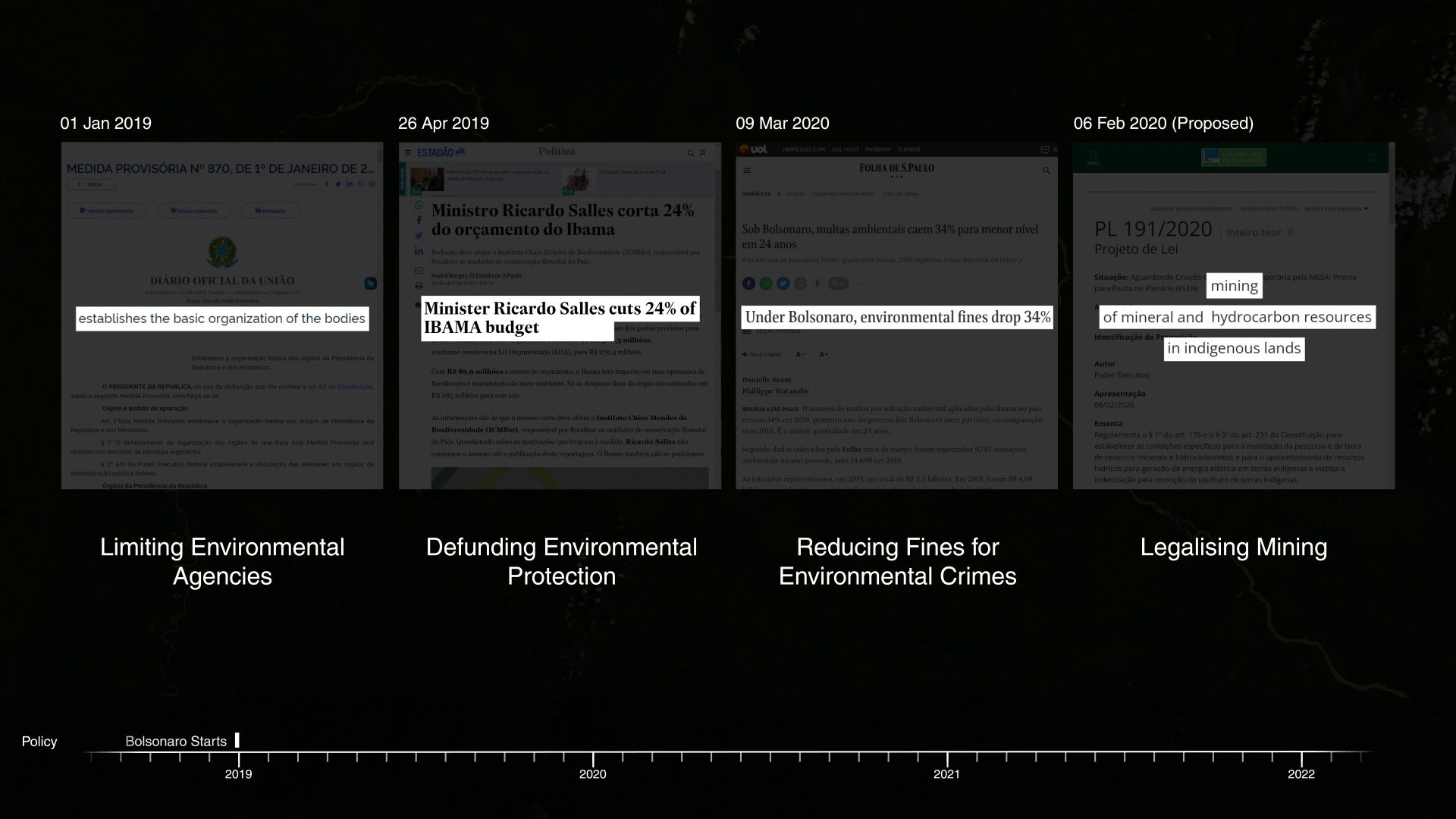
Since Bolsonaro took office in 2019, his administration has adopted policies that both directly and indirectly encourage gold mining on Indigenous land. We analysed the timing and implications of dozens of policies and actions of the Bolsonaro administration in relation to rates and patterns of deforestation, as well as incidents of violence against the Yanomami people in the region. We found that these policies constitute at least four strategies that seek to support gold mining and undermine Indigenous sovereignty. These include:
- weakening environmental protection agencies
- defunding environmental protection agencies
- reducing fines for environmental crimes
- attempted legalisation of mining on Indigenous land
Violent attacks against Yanomami villages
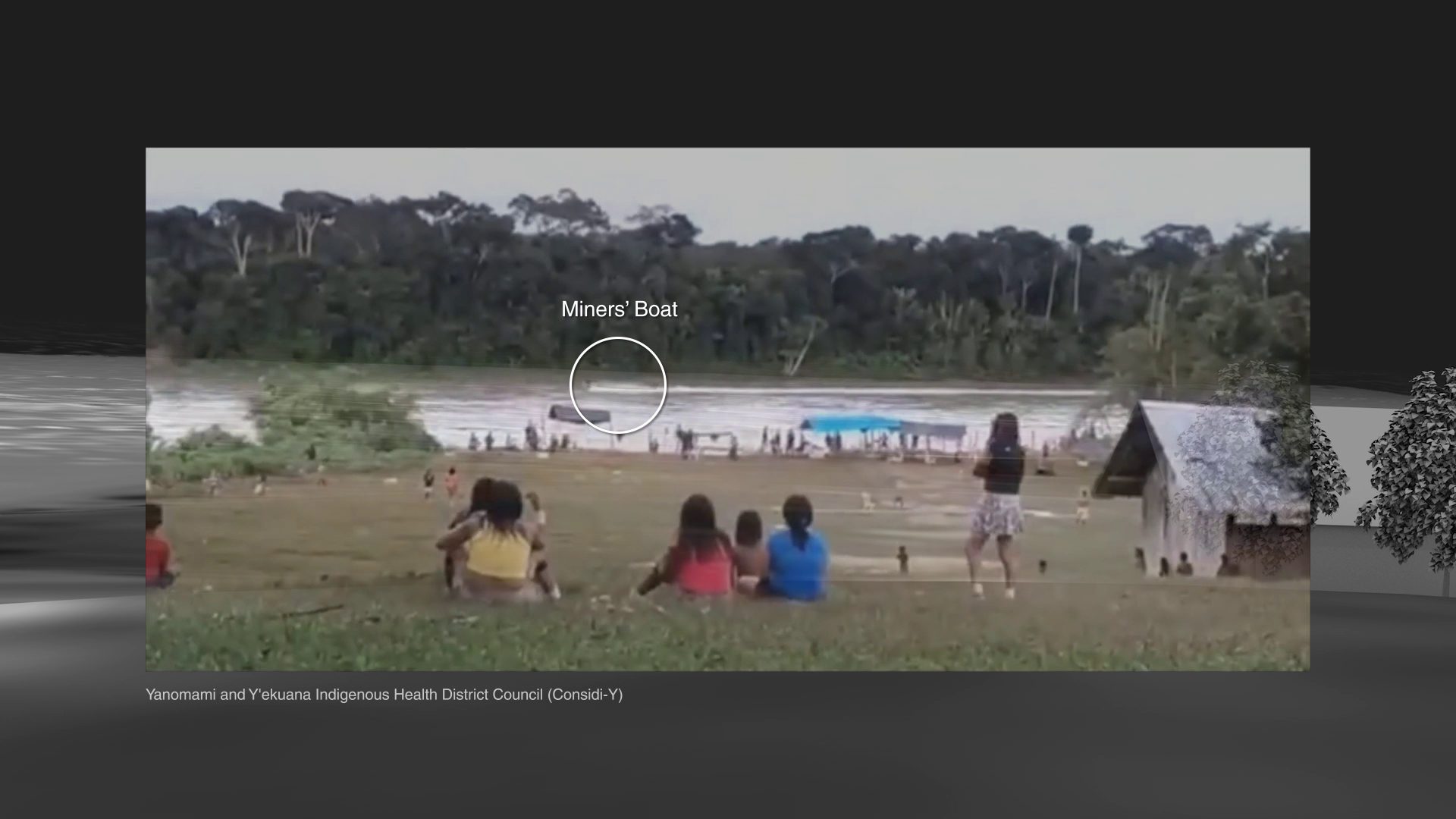
Since 2019, Indigenous communities in Brazil have seen an increase in attacks by ‘wildcat’ miners. We mapped the time and location of about a dozen attacks on Yanomami people in the past two years along the Uraricoera River. Palimiu village in Roraima state, for example, saw six violent attacks in 2021 alone. Of these, we investigated the circumstances and timeline of two attacks in Palimiu that took place on 10 and 11 May 2021.
Our investigation shows that the two attacks were carried out by gold miners and likely hired mercenaries from the Sao Paulo-based criminal organisation Primeiro Comando da Capital (PCC). In both attacks, miners and/or members of the PCC fired at the Palimiu community from several boats passing on the river. The attacks were reportedly intended as retaliation for resistance by the Palimiu community to the ongoing mining, including their confiscation of miners’ vehicles and fuel.
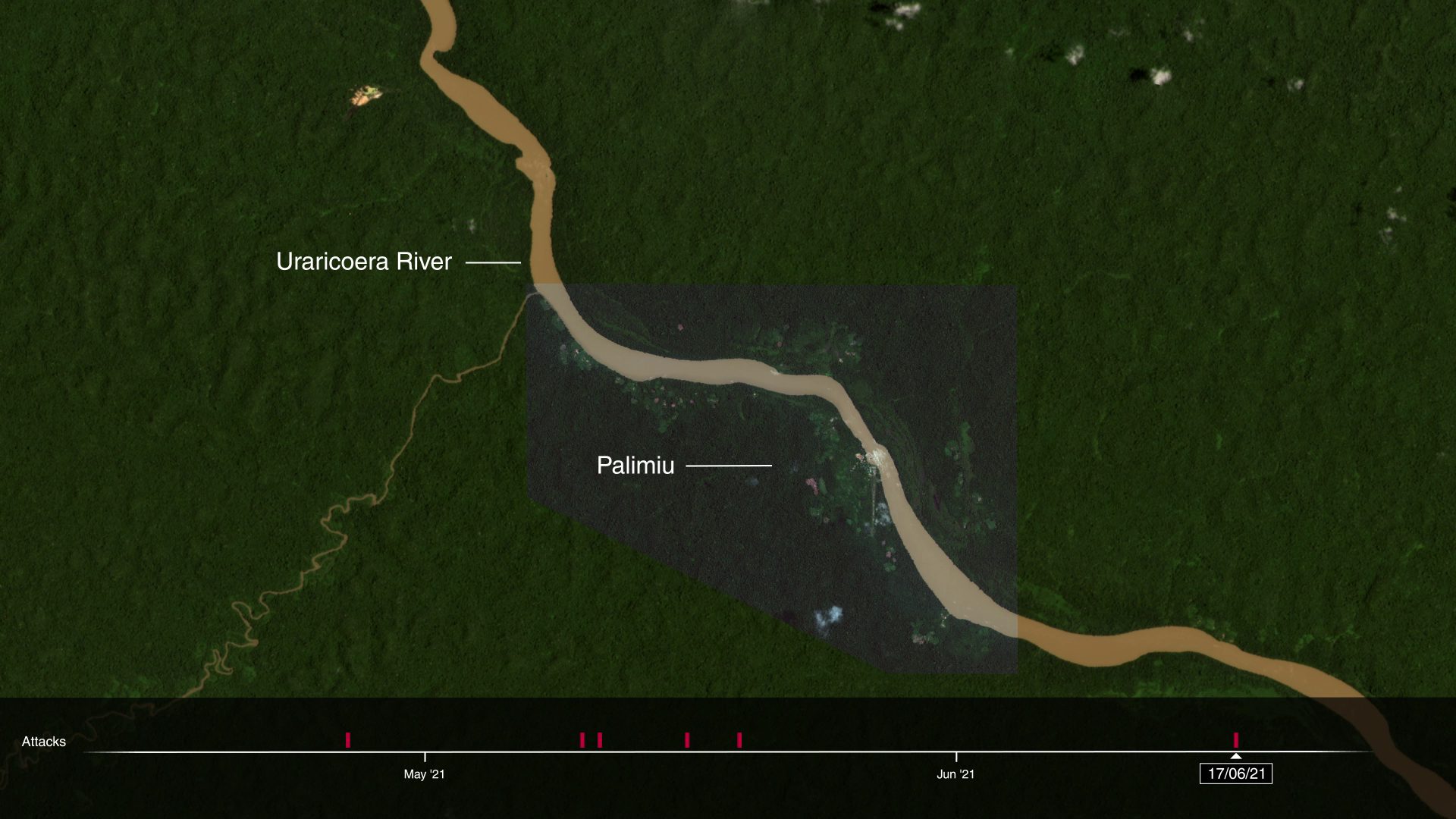
By geolocating the incidents and placing them on a timeline of other attacks in Yanomami land, our incident analysis supports Instituto Socioambiental (ISA)’s recent studies of violence against the Yanomami people.
Environmental destruction in the Amazon Rainforest
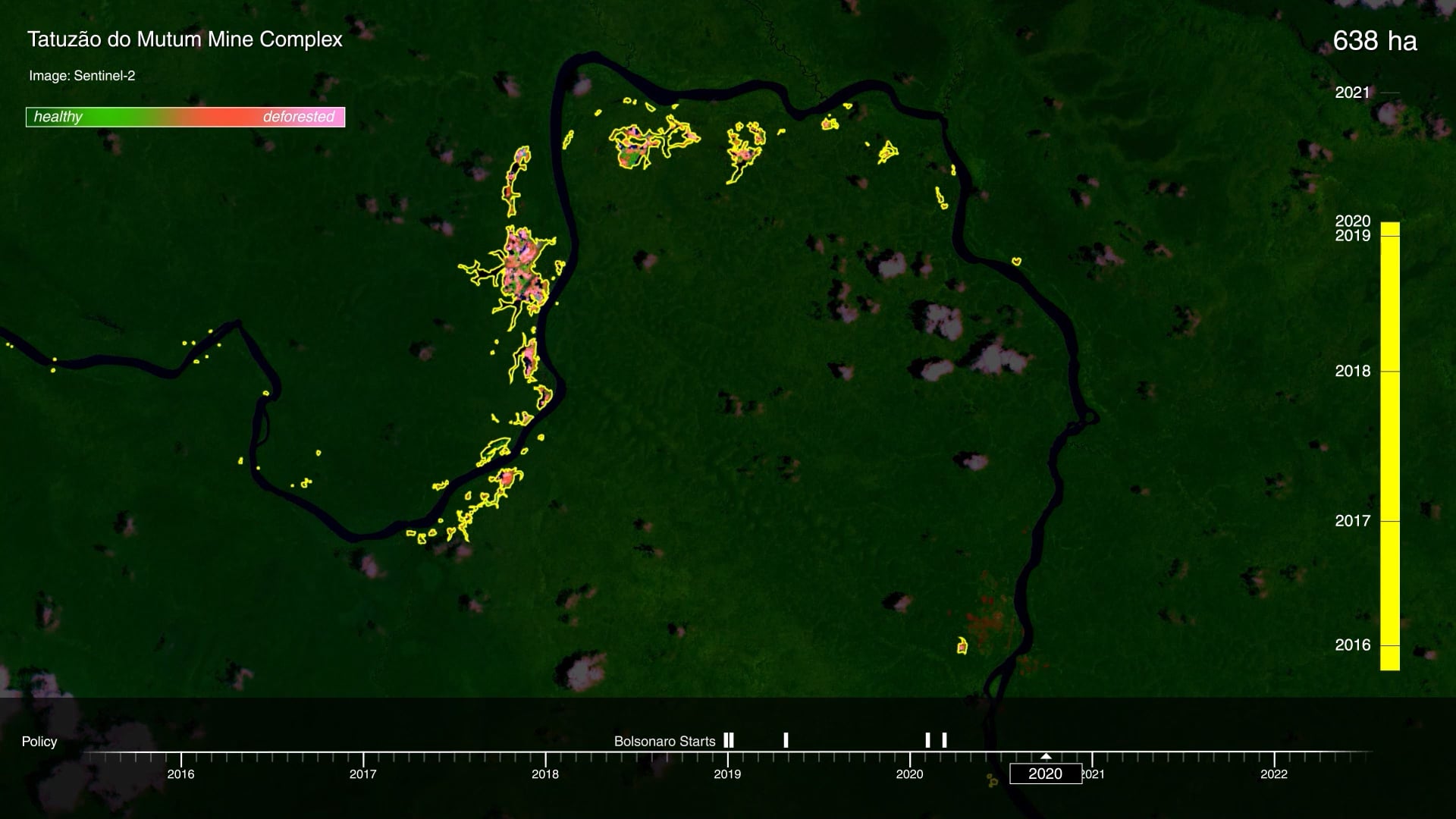
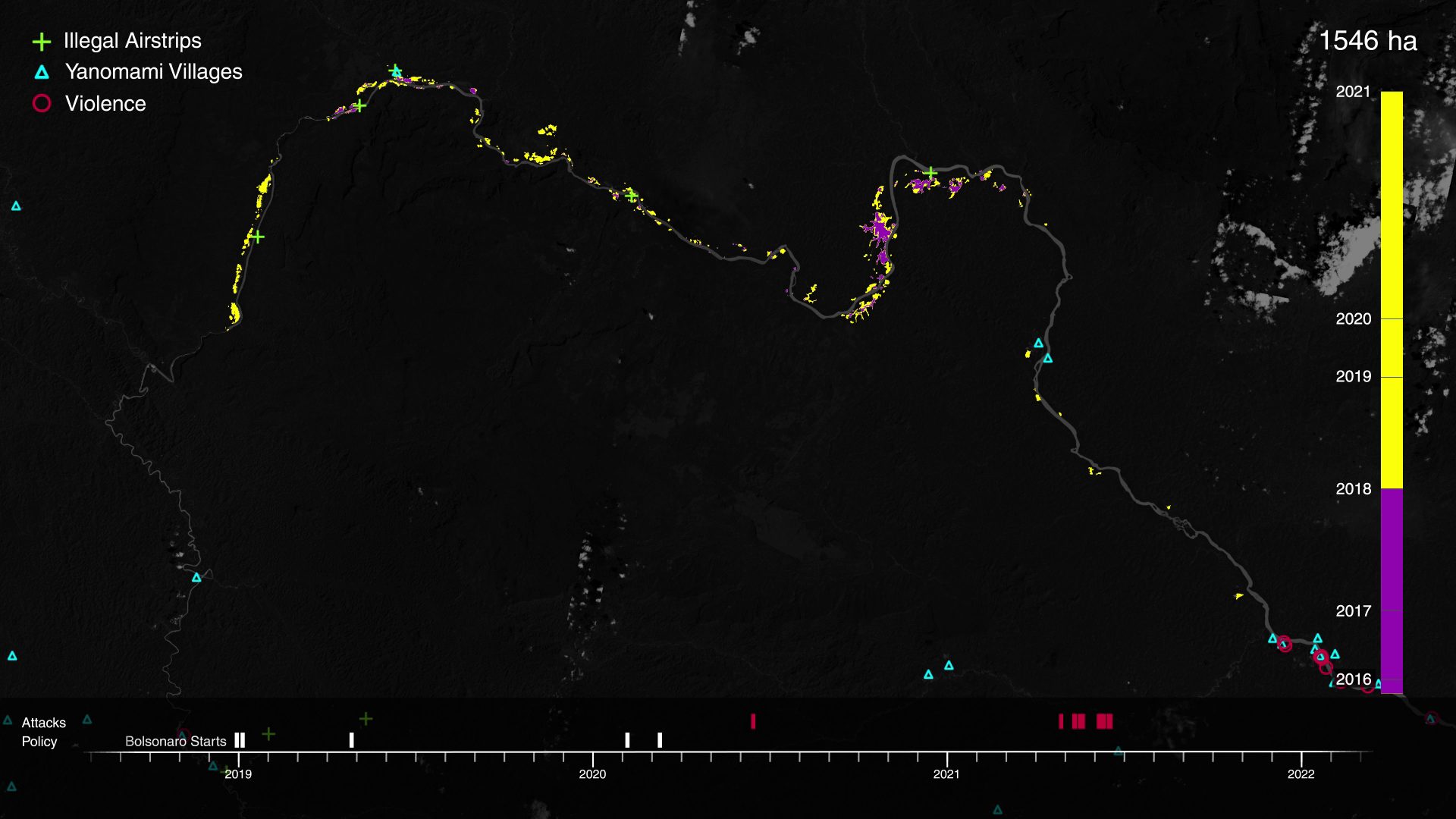
Using satellite imagery, GIS and remote sensing analysis techniques, we analysed the geographic location of illegal gold mines along the Uraricoera River, their spatial features, patterns of growth and proximity to Yanomami villages between 2016 and 2022. We also tracked and calculated the annual rate and spread of deforestation caused by these mines before and after Bolsonaro took office.
Over the three years preceding Bolsonaro’s rise to power in 2019, mining along the Uraricoera River expanded by 500 hectares. In the three years since Bolsonaro has been in office, the rate of growth has doubled, with mines ravaging a further 1,000 hectares of the Amazon Rainforest.
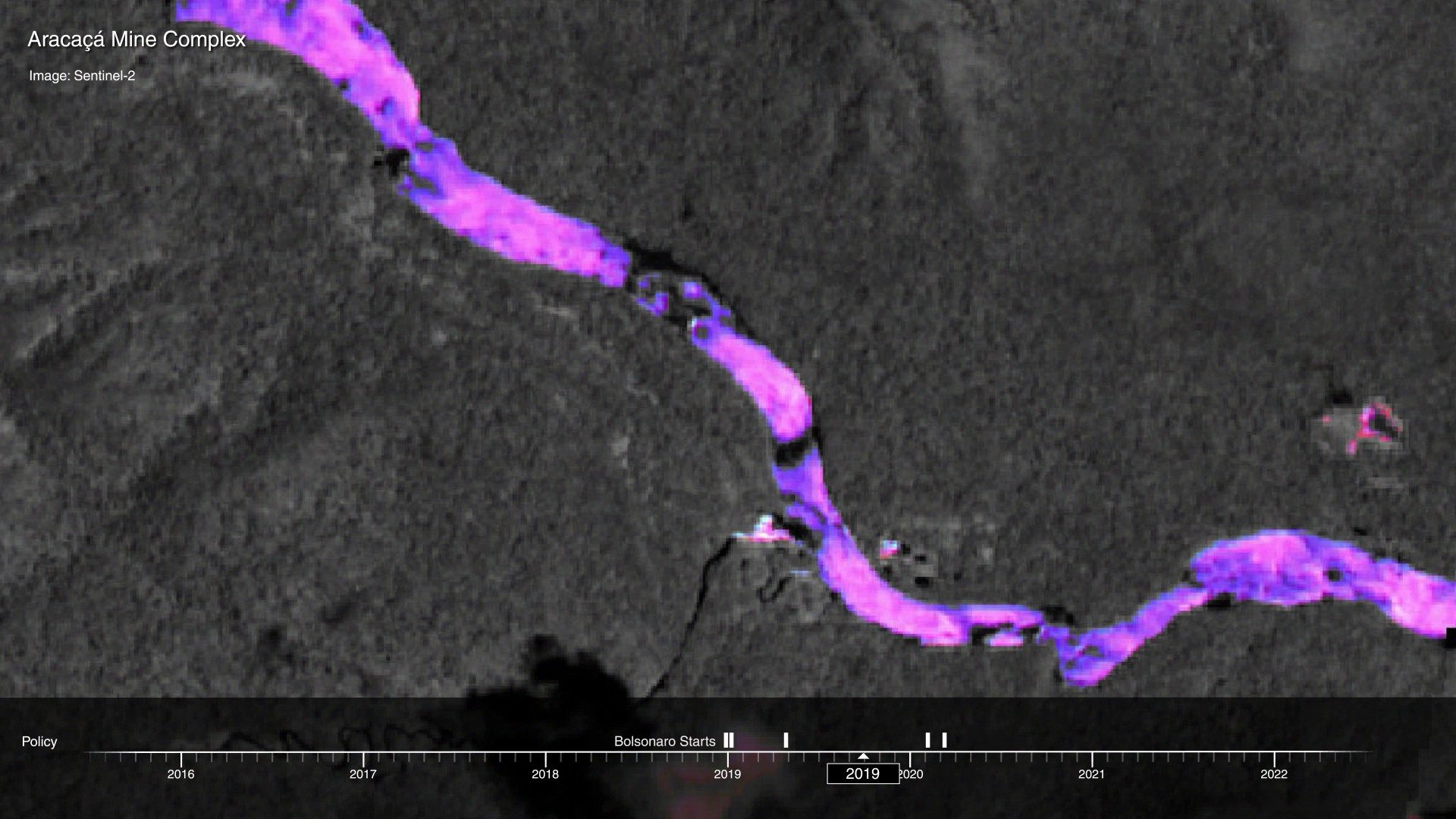
Employing remote sensing analysis, we found visual evidence of the runoff from a mine complex near the Aracaca village, likely containing toxic mercury that compromises the natural ecosystems and water sources for Yanomami villages. Our study supports existing health reports on the correlation between mercury (Hg) contamination and artisanal small-scale gold mining (ASGM) in the region.
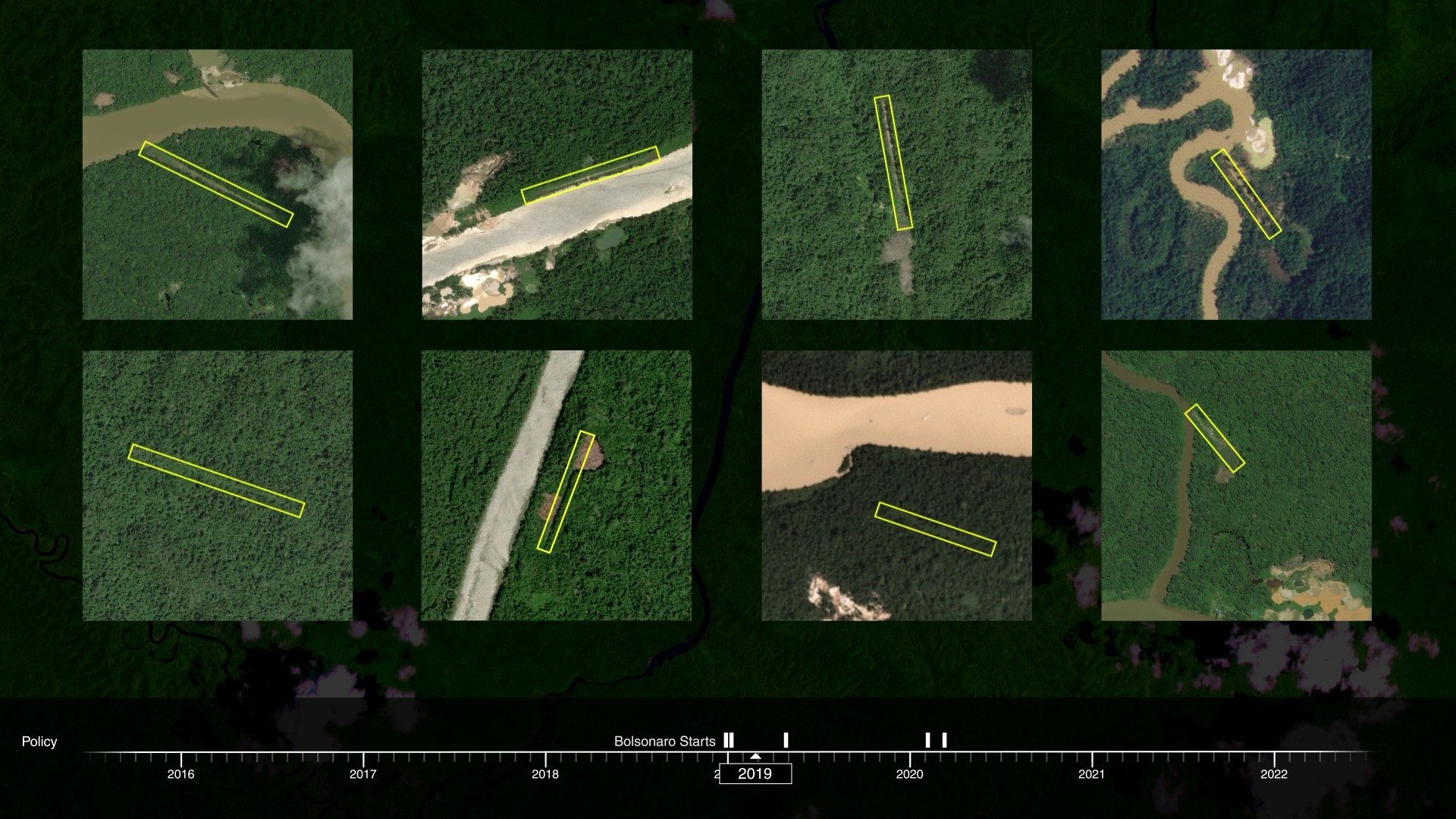
In the study of one group of mines, also near Aracaca, we found that they had been developed entirely after Bolsonaro took office in 2019, and only after an illegal airstrip was established there. Through satellite imagery analysis, we found eight examples where there was a close correlation between illegal airstrips and gold mining growth in the Yanomami territory; this is evidence that illegal airstrips are likely to indicate new mining activity and future deforestation.
Conclusion
We placed the findings from each of the three aforementioned areas of analysis into a timeline to study, for the first time, how Bolsonaro’s policies affected the rate of deforestation and the number of violent attacks against Yanomami people.
Our evidence clearly suggests that the Bolsonaro government’s policies and rhetoric leading up to and during his presidential term correspond in timing to the rapid increase in environmental destruction and violence against Indigenous people across the Amazon. Given that those territories under Indigenous stewardship are among the best preserved areas in the Amazon rainforest, and that deforestation in the Amazon is itself a major contributor to global climate change, upholding Indigenous land rights becomes a matter of both sovereignty and survival.
‘Because these Indigenous lands are very remote, and because reporting from these areas have become very dangerous to journalists and human rights activists – as the recent assassinations of Bruno Pereira and Dom Philips painfully showed us – the public gets only glimpses of the violence that is being inflicted in these territories, so they appear as sporadic and disconnected events. Using satellite data and video analysis, the investigation allows us to see the broader, systemic logics of these human rights and land violations, showing that they are entangled with rising deforestation, and also directly related to the virulent anti-Indigenous and anti-environment rhetoric and policies of the Bolsonaro government.’
—Professor Paulo Tavares, a Forensic Architecture Research Collaborator at the University of Brasilia
This material is based on work supported by Stichting Foundation for International Law for the Environment (FILE), through a grant to New York University (NYU). Any opinions, findings, and conclusions are those of the author(s) and do not necessarily reflect the views of the FILE or NYU.