- Date of Incident
- 11 Sep 2012
- Location
- Karachi, Pakistan
- Publication Date
- 30 Jan 2018
- Commissioned By
- European Center for Constitutional and Human Rights (ECCHR)
- Additional Funding
- European Center for Constitutional and Human Rights (ECCHR)
- Methodologies
- 3D Modelling, Fluid Dynamics, Image Complex
- Forums
- Regional Court in Dortmund, Germany
- Exhibitions
- République Géniale, Forensic Architecture: Design as Investigation, Investigative Commons, Around the Clock: The Factory Effect, Of Thread and Stone
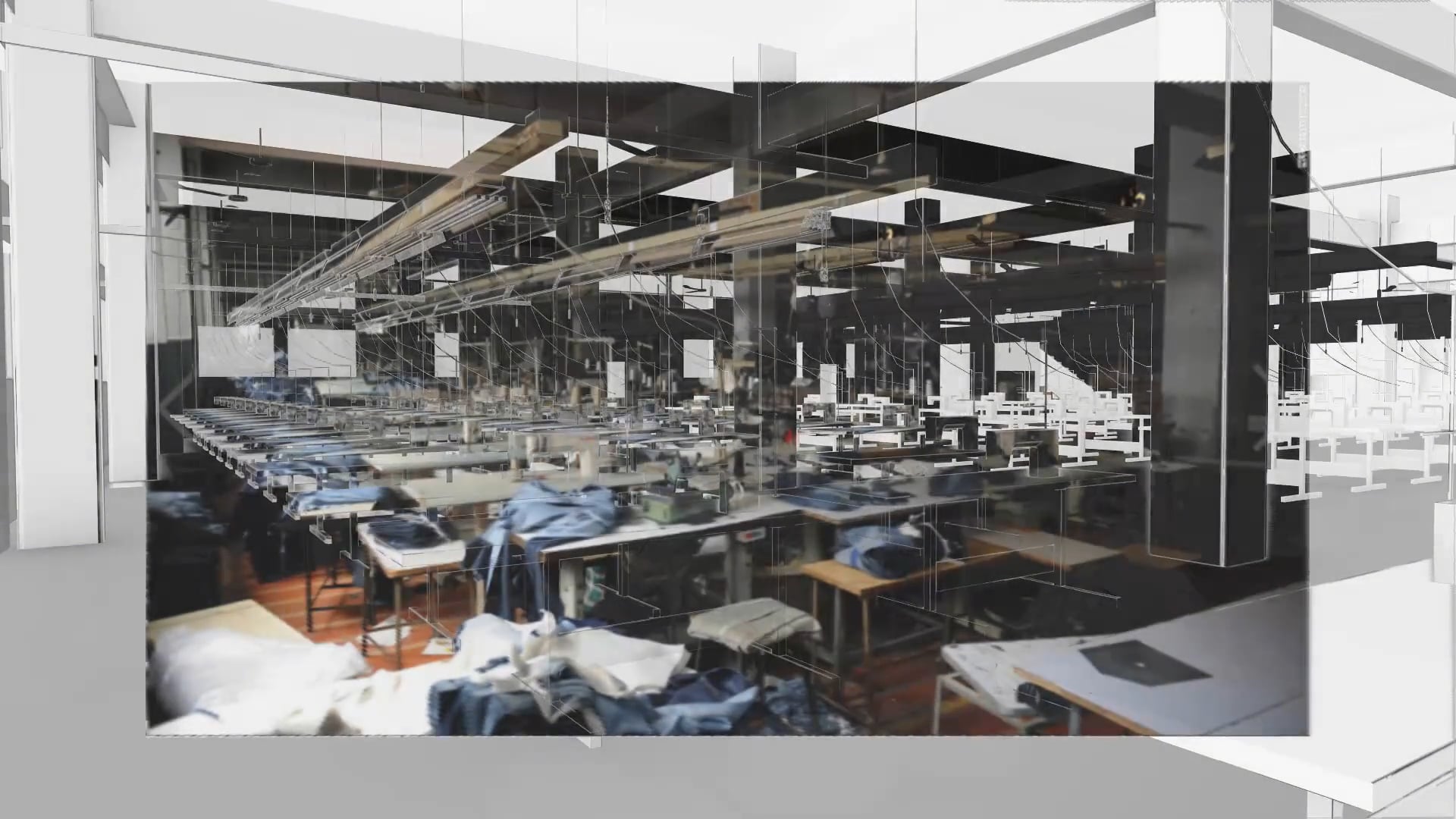
259 people died when the Ali Enterprises textile factory in Karachi, Pakistan, was gutted by fire on 11 September 2012.
Inadequate fire safety measures at the factory, a supplier for the German clothes retailer KiK, led to the catastrophic death toll. This investigation uncovers the many ways in which design and management decisions not only failed to prevent injury and casualties, but in fact augmented the death toll.
Forensic Architecture (FA) was commissioned by the European Center for Constitutional and Human Rights (ECCHR) to carry out an architectural analysis of the fire.
Our findings have now been submitted to the Regional Court in Dortmund, Germany, where legal action against KiK is ongoing. Since March 2015, the Court has been examining a civil claim against KiK filed by four claimants—one survivor and three relatives of workers killed in the fire—with support from the ECCHR and Medico International.
Methodology
Our analysis of the building and the incident was based on available satellite and ground-level photography, witness sketches, and survivor testimonies, as well as previous investigative reports by Pakistan’s Federal Investigative Agency, and a joint investigative team established to investigate the case.
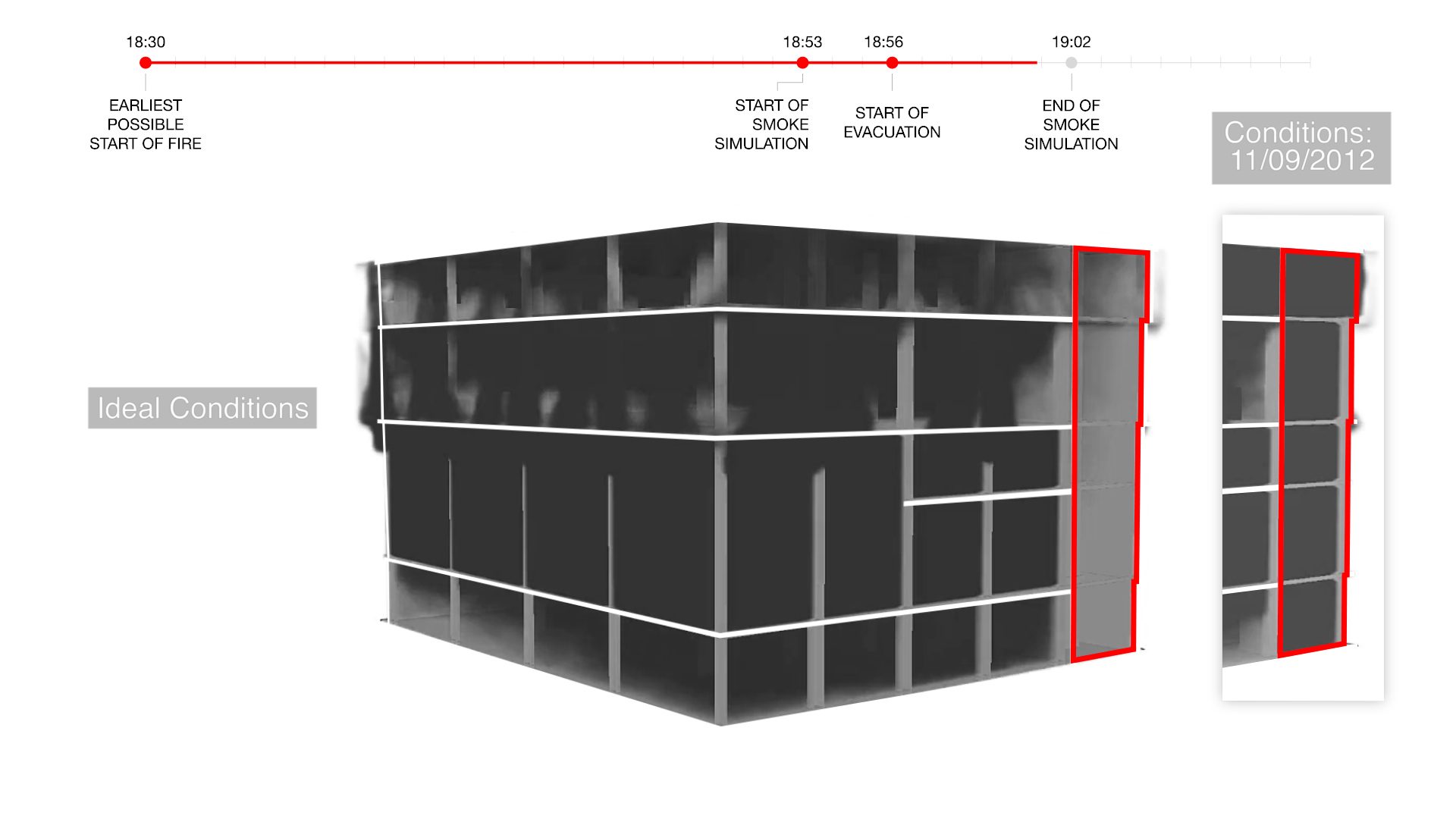
As part of our analysis, we constructed a 3D model and a film that illustrates and simulates the path of the fire and studies the building’s vulnerability to it. We also collaborated with other specialists in order to simulate the smoke propagation and the paths that the occupants used to escape the building.
We used crowd and smoke simulations to recreate the actual conditions of the fire, and to test how other, legally-compliant variations in the architecture of the factory would have led to different outcomes during evacuation.