

- Date of Incident
- 06 Nov 2017
- Location
- Mediterranean Sea
- Publication Date
- 04 May 2018
- Commissioned By
- Self-Initiated
- Additional Funding
- Republic and Canton of Geneva, Open Society Foundations (OSF), Swiss National Science Foundation, WatchTheMed Platform
- Collaborators
- Republic and Canton of Geneva, Swiss National Science Foundation, WatchTheMed Platform, Sea Watch e.V.
- Methodologies
- Synchronisation, 3D Modelling, Remote Sensing
- Forums
- European Court of Human Rights
- Exhibitions
- Counter Investigations, Error: The Art of Imperfection, Tierra Prometida, Constellation Malta, Liquid Violence at Kunstenfestivaldesarts 2019, Liquid Violence at Manifesta 12, Under the Radar, Violence, Fast and Slow, Forensic Architecture: True to Scale, Forensic Oceanography at Our Present, Forensic Oceanography at Sea Around Us, The Biennale de l'Image Possible in Liège | BIP2020, Liquid Violence at Short Festival, Beyond States – The Boundaries of Statehood, Forensic Architecture: Practices of Verification, Atlantropa Will Not Take Place
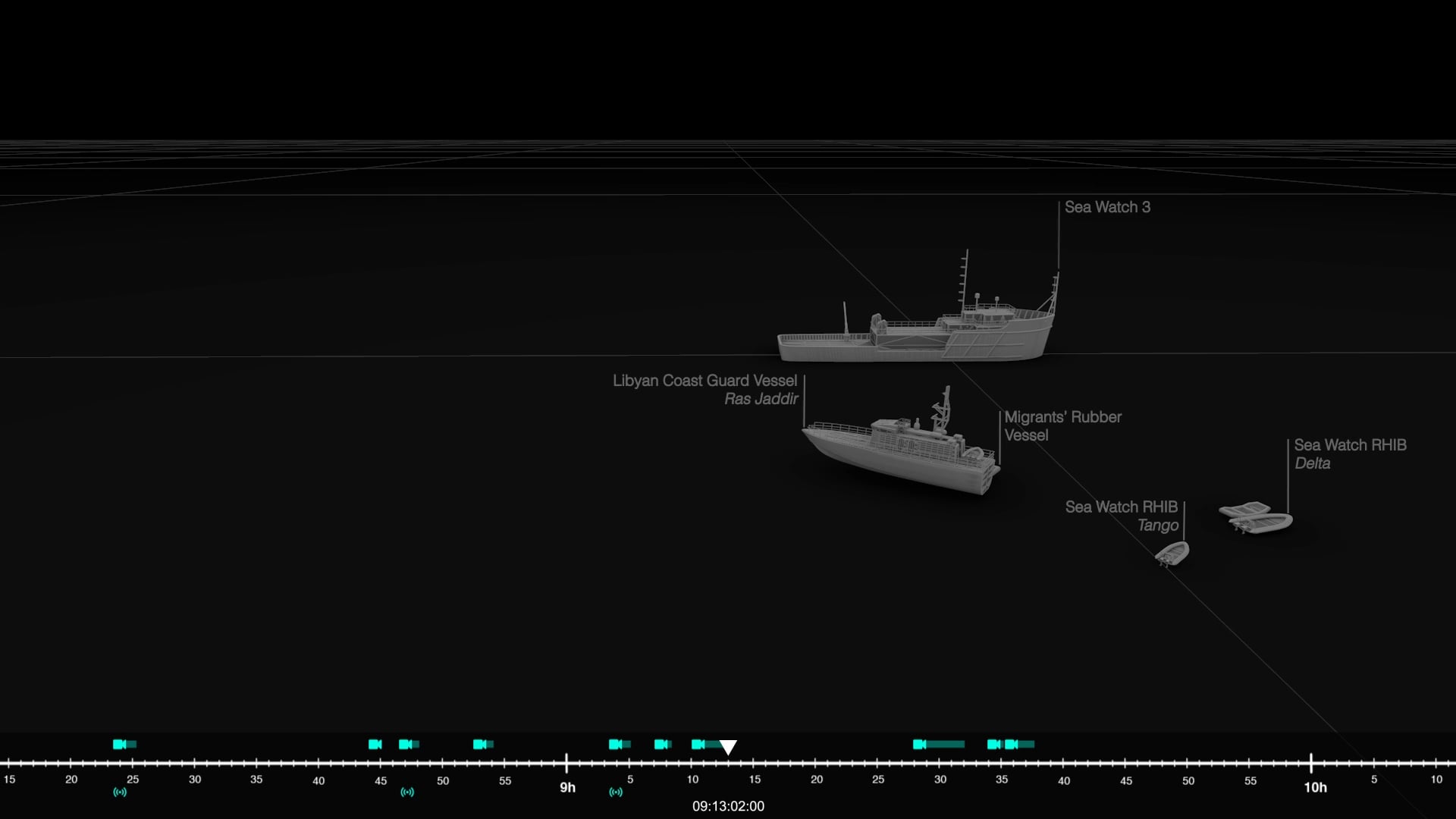
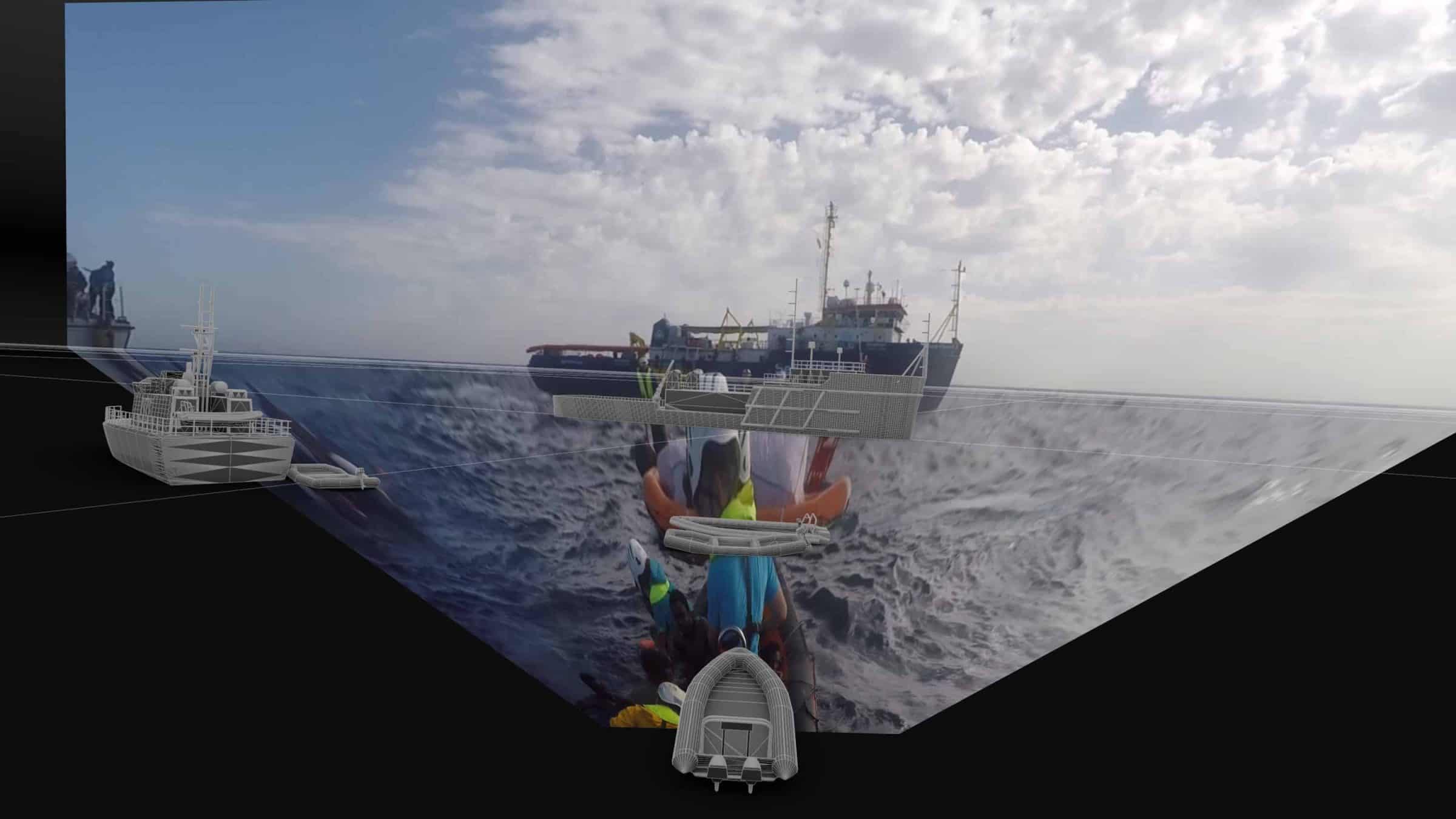
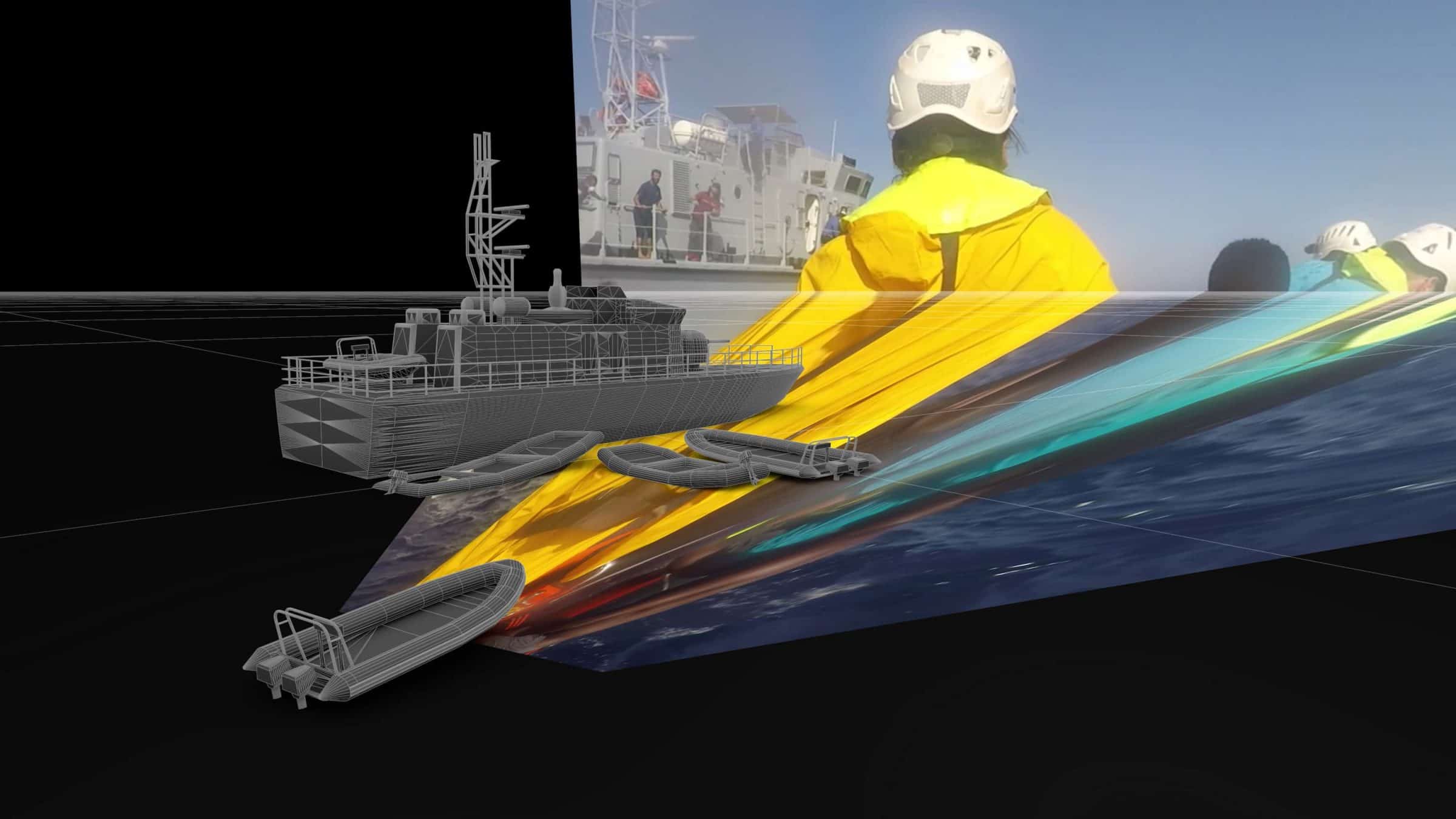
On 6 November 2017, a rescue vessel operated by the NGO Sea Watch (SW) and a patrol vessel of the Libyan coastguard were both en route towards a migrants’ boat, in distress in international waters.
The boat, a few hours out of Tripoli, was carrying between 130 and 150 passengers. A confrontational rescue operation ensued, and while SW was able to rescue fifty-nine passengers, bringing them to safety in Italy, at least twenty died before or during the incident, while forty-seven passengers were ultimately ‘pulled back’ to Libya, where several faced grave human rights violations – including being detained, beaten, and sold to another captor who tortured them to extract ransom from their families.
Before arriving on the scene, the Libyan vessel made contact with the Maritime Rescue Coordination Centre of the Italian coastguard, which informed them of a boat in distress. The vessel, the Ras Jadir, was one of four boats donated by Italy to the Libyan coastguard in May 2017; eight of the thirteen crew that day had been trained by the EU’s anti-smuggling operation, EUNAVFOR MED.
The way in which this incident played out is paradigmatic of new, drastic measures implemented by Italy and the EU in an attempt to stem migration across the central Mediterranean. This attempt follows a two-pronged strategy.
On one hand, European authorities aim to delegitimise and criminalise rescue NGOs, with the intention of ultimately ousting them from the central Mediterranean. On the other, those authorities provide material, technical, and political support to Libya’s coastguard, encouraging and enabling them to intercept boats and ‘pull back’ migrants to Libya.
A cornerstone of international law concerning refugees is the principle of ‘non-refoulement’: a refugee cannot be deported to a country in which they are likely to be the subject of persecution.
Through policy agreements and practical support, Italy and the EU have come to exercise strategic and operational control over the Libyan coastguard, guiding and inducing them to conduct ‘refoulement by proxy’.
Updates
Update — 26 December 2018
Forensic Architecture and Forensic Oceanography partner with the New York Times to publish a new version of the investigation, as part of an Opinion section long-read.