

- Date of Incident
- 01 Oct 2016
- Location
- Evros/Meriç river, Greek-Turkish border
- Publication Date
- 19 Oct 2020
- In Partnership With
- HumanRights360
- Additional Funding
- Open Society Foundations (OSF)
- Collaborators
- HumanRights360, HIAS Greece, Global Legal Action Network (GLAN), Greek Council for Refugees
- Methodologies
- Situated Testimony, 3D Modelling, Fieldwork, Geolocation, Ground Truth, Remote Sensing, Software Development
- Forums
- Legal Process, Human Rights Report, Media
- Exhibitions
- This World is White No Longer: Views of a Decentered World, Investigative Commons, Forensic Architecture. Border Violence Across the Evros/Meriç River: Situated Testimony, Forensic Architecture: Witnesses
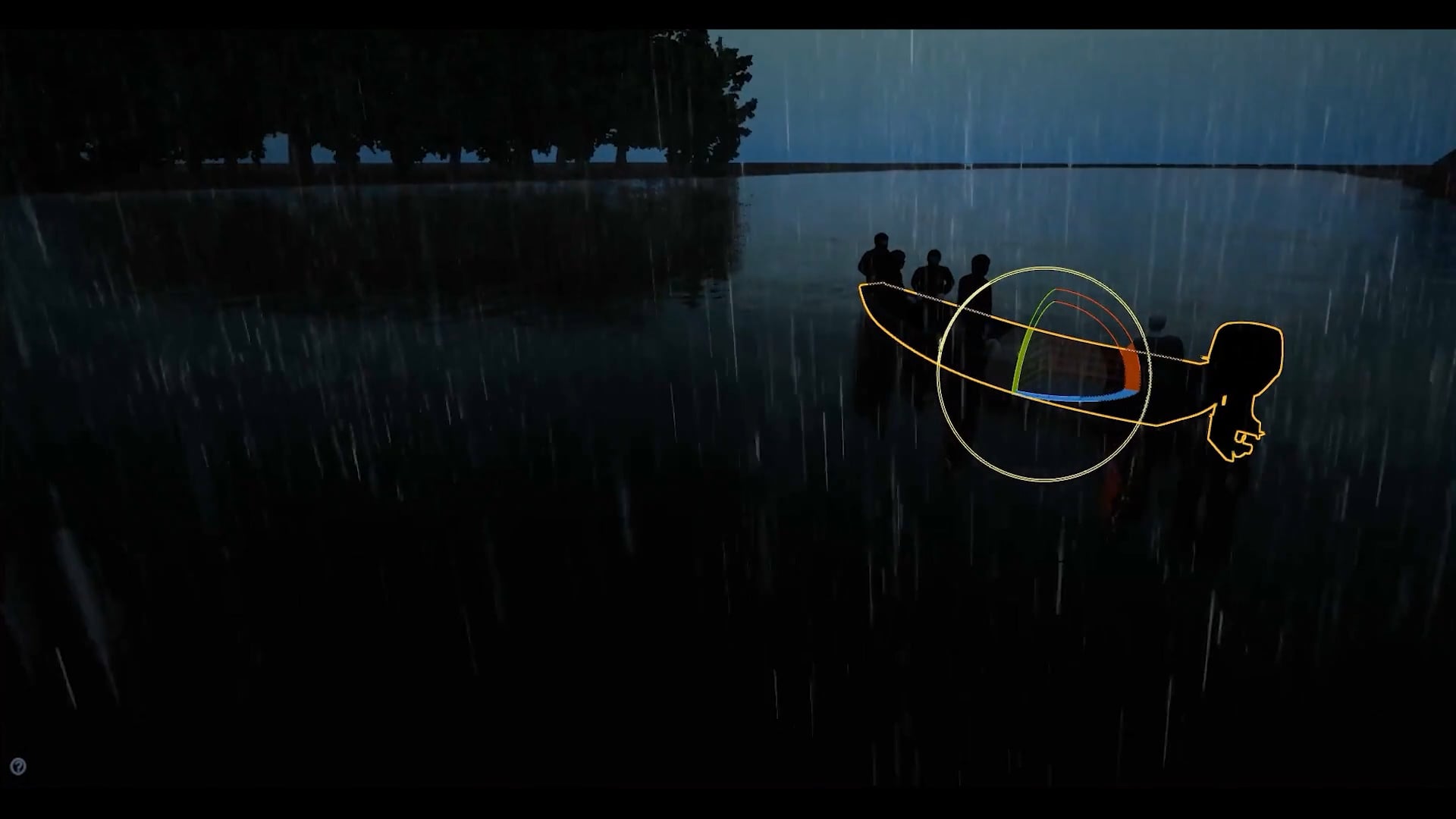
For years, migrants and refugees crossing the Evros/Meriç River from Turkey to Greece have testified to being detained, beaten, and ‘pushed back’ across the river to Turkey, by unidentified masked men, in full secrecy, at night, and without being granted access to asylum procedures.
Greek and EU authorities systematically deny any wrongdoing and refuse to investigate these reports.
The Evros/Meriç river delineates the only ‘land’ border between Greece and Turkey. Spanning from the trilateral border with Bulgaria in the north, where the river is called Maritsa, to the Aegean Sea in the south, this so-called ‘natural’ border has in recent years been incorporated into a wider ecosystem of border defence. Its natural processes have been weaponised to deter and let die those who attempt to cross it and to obfuscate this violence and deflect responsibility.
For independent researchers, the militarisation of this border region makes access extremely difficult; a restricted ‘buffer zone’ runs along both banks of the river. Detention centres and border guard stations are often located within this buffer zone, keeping detained people out of sight and without access to legal support.
Witnesses describe having their phones, documents, and possessions confiscated and often thrown into the river, suggesting an operation that is carefully designed to remove any potential evidence of human rights violations.
Using an interview technique called ‘situated testimony’ we collected and corroborated evidence to prove the practice of ‘pushbacks’ at Evros/Meriç river, are methodical and widespread, and to identify the agents and agencies responsible. Situated Testimony is a technique of interviewing developed by Forensic Architecture, which uses 3D models of the scenes and environments in which traumatic events occurred to aid in the process of interviewing and gathering testimony from witnesses to those events. Together with an architectural researcher, a witness is filmed reconstructing the scene of an event, exploring and accessing their memories of the episode in a controlled and secure manner.
The Case of Fady
The Case of Kuzey
Methodology
Using a technique called ‘situated testimony’, where witnesses are interviewed using 3D models of the scenes and environments in which traumatic events occurred, we helped witnesses reconstruct their experiences.


With the help of architectural software, witnesses described and modelled in 3D the buildings they were detained in.


We used Unreal Engine, a gaming software, to model the vehicles in which witnesses were transported, as well as the attire and gear of the operatives who had pushed them back.


Witnesses modelled the sequence of their pushback, the river landscapes that they were forced to cross, and the weather conditions at the time. What emerges is a picture of a violent practice where beatings are customary, at times amounting to torture. A second layer of violence also emerges, which is inflicted through the natural elements and the geography of the river.


To do this, we produced an object library that included vehicles, uniforms, weapons that we know to be used by border patrol agencies in the region, and different vegetation types that make up the riparian vegetation of Evros/Meriç. We assembled this library through rigorous fieldwork, and by studying operational documents as well as scientific texts.


Using further evidential material like satellite images, maps, official documents, videos, photographs, and meteorological data, we were able to corroborate these testimonies and identify some of the places and actors involved. These included Greek police, border guards, and military, and sometimes civilians and German-speaking personnel.


At the end of each interview, the witnesses were presented with precise models and photographs of specific police and border guard stations, modelled from satellite imagery and ground footage. Through this verification process, the witnesses were able to identify four different border guard stations that they were held in, at Tychero, Poros, Feres, and Soufli.


We mapped out the paths of these four witnesses as they entered Greece and were repeatedly expelled, demonstrating that pushbacks in the region are both systematic and widespread.


To present this depth of evidence, we created an interactive interface that helps navigate each testimony in chapters, as well as allows viewers to access additional evidence and examine the models built by each witness.
Updates
Update — 17 November 2020
HumanRights360 and Global Legal Action Network (GLAN), representing Fady, submitted a complaint against Greece to the United Nations Human Rights Committee. Read the complaint here.